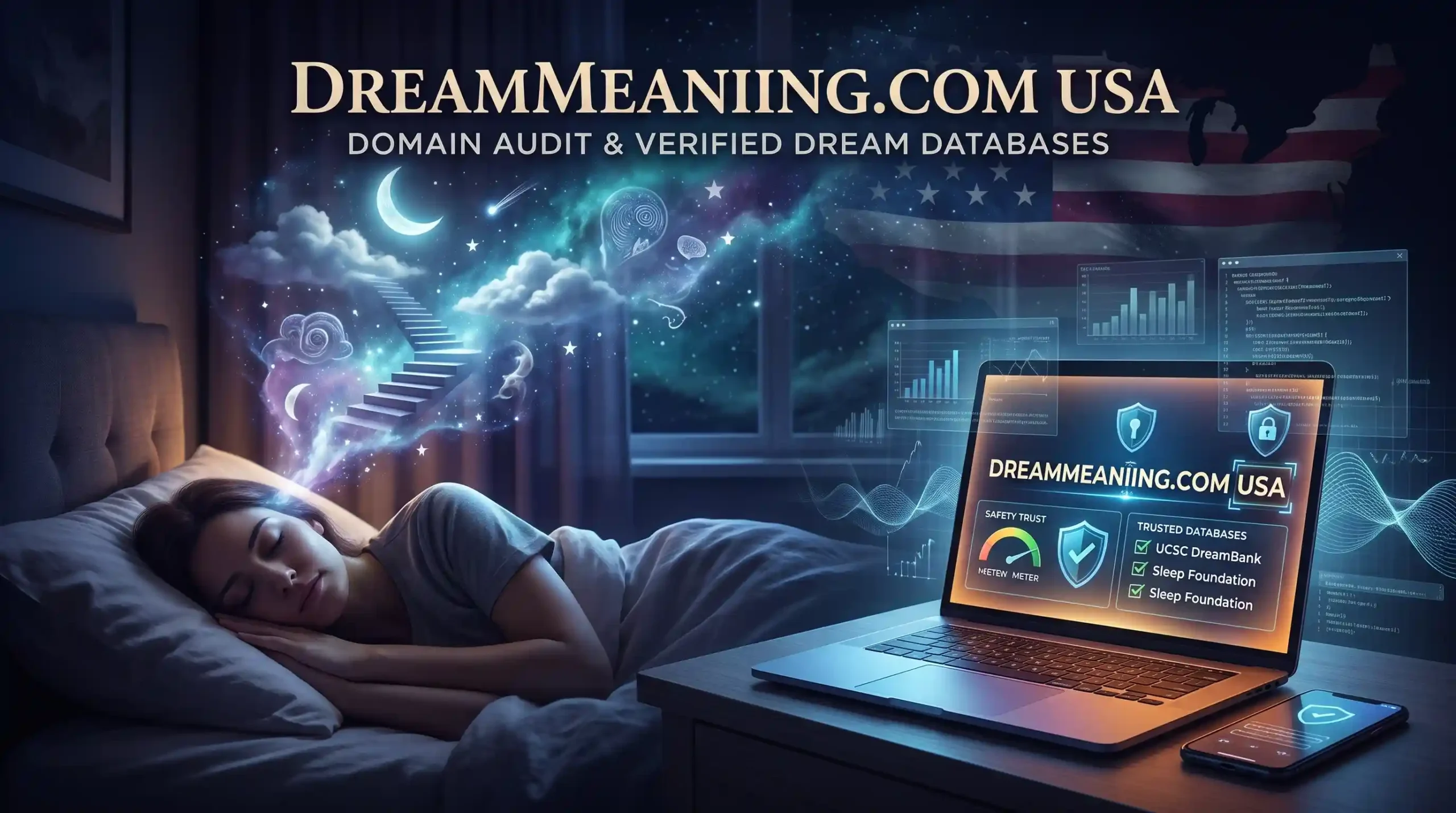
DreamMeaniing.com USA: Domain Audit, Verified Dream Databases & Clinical Interpretation Guide
DreamMeaniing.com USA refers to U.S. search traffic targeting the double-“i” typographical variant of dreammeaning.com, a query pattern linked to parked ad-arbitrage redirects and content farms rather than a recognized clinical sleep organization or verified psychological database. Users seeking accurate symbol lookups or scientific sleep analysis in the United States should bypass unverified typo-domains in favor of peer-reviewed repositories like the UC Santa Cruz DreamBank, the International Association for the Study of Dreams (IASD), or established encyclopedias such as DreamMoods.
Typographical domains thrive on midnight search habits. Millions of Americans wake from vivid Rapid Eye Movement (REM) episodes, grab a smartphone in a dark room, and mistype query strings into mobile browsers. That extra letter “i” in dreammeaniing.com separates established reference directories from rotating affiliate lander pages, browser notification traps, and scraped glossary blogs. Evaluating both the technical infrastructure behind these domains and the actual science of sleep cognition protects your personal data while giving you an accurate framework for decoding subconscious imagery.
Platform Verification & U.S. Dream Database Comparison
| Platform / Domain | Operational Status (Oct 2026) | Best For | Methodology & Data Source | Primary Limitation |
| DreamMeaniing.com (Double-“i”) | Unverified Typo-Variant / Variable DNS | Identifying mistyped URL redirects | Automated content scraping or search-feed ad arbitrage | High risk of domain parking, pop-up redirects, and zero clinical oversight |
| DreamBank.net (UC Santa Cruz) | Active Academic Repository | Empirical research & quantitative pattern matching | Over 20,000 authenticated dream reports analyzed via the Hall/Van de Castle coding system | Interface is built for academic queries rather than casual symbol browsing |
| DreamMoods.com | Active U.S. Commercial Reference | Fast alphabetical lookups of common cultural tropes | 6,000+ cross-indexed cultural, Jungian, and popular symbol entries | Relies on generalized fixed symbolism rather than individual personal context |
| IASD (ASDreams.org) | Active 501(c)(3) Nonprofit (U.S.) | Peer-reviewed sleep research & ethical clinical frameworks | Multidisciplinary academic papers from neurologists, psychologists, and anthropologists | Does not offer an instant one-word “fortune cookie” lookup tool |
| SleepFoundation.org | Active Medical Review Board Portal | Understanding nightmare disorders, REM physiology, and sleep hygiene | Physician-reviewed medical synthesis aligned with AASM clinical guidelines | Focuses on sleep mechanics and pathology rather than symbolic dictionary entries |
Technical Audit of the DreamMeaniing.com Domain Pattern
Search queries combining a specific misspelled domain with a geographic modifier like dreammeaniing.com usa typically stem from three technical mechanisms: mobile keyboard fat-fingering, browser autocomplete pollution, or regional ad-network routing.
When a user types a double “i” into an address bar, DNS resolution checks whether an active registrant holds the exact string. In the secondary domain market, registrars and monetization networks frequently register one-character permutations of high-traffic dictionary terms. These domains operate under two distinct models:
-
Zero-Click Parking and Search Feed Arbitrage: The domain resolves to a lightweight HTML shell hosting programmatic pay-per-click (PPC) links generated by upstream ad feeds. If you access the URL from a U.S. IP address, geolocation scripts detect your region and serve high-CPC domestic advertisements (often pushing paid psychic readings, horoscope subscriptions, or questionable browser extensions).
-
Programmatic Content Farms: Operators deploy mass-generated WordPress or static site instances populated with thousands of spun articles matching long-tail queries (“what does dreaming about teeth falling out mean in USA”). These sites lack named editorial boards, medical reviewers, or verifiable corporate registrations in U.S. state secretary databases.
How to Inspect Any Dream Lookup Domain Before Interacting
Before clicking internal links or allowing browser permissions on an unfamiliar sleep portal, run a three-step technical check using standard command-line tools or public registries:
# 1. Check authoritative DNS records and hosting provider
dig dreammeaniing.com ANY +noall +answer

# 2. Inspect HTTP redirect chains without rendering JavaScript or tracking pixels
curl -ILs https://dreammeaniing.com | grep -E "HTTP/|Location:|Server:"

# 3. Query ICANN / RDAP registration metadata for registrant transparency
curl -s https://rdap.verisign.com/com/v1/domain/dreammeaniing.com | jq '.entities, .events'
If the curl -ILs output displays multiple 302 temporary redirects bouncing through affiliate tracking parameters (?click_id=, subid=, or unfamiliar ad-exchange domains), close the tab immediately. Legitimate informational sites serve a clean HTTP/2 200 response directly from a recognizable content delivery network like Cloudflare, Fastly, or AWS CloudFront. You can also verify domain ownership history directly through the ICANN Lookup Portal to confirm whether a site is newly registered or hidden behind offshore privacy proxies.
Verified U.S. Databases for Dream Research and Symbol Analysis
If your goal in searching for dreammeaniing.com usa was to find an authoritative American directory for analyzing nighttime imagery, four established platforms provide transparent sourcing without deceptive redirect chains.
1. UC Santa Cruz DreamBank (DreamBank.net)
Developed by psychologists William Domhoff and Adam Schneider at the University of California, Santa Cruz, DreamBank is the gold standard for empirical dream research in the United States. Instead of inventing arbitrary meanings for symbols, DreamBank houses over 20,000 actual dream transcripts collected from diverse demographic groups across decades. Users can run boolean searches across age groups, genders, and longitudinal single-person series (such as the famous “Dorothea” or “Izzy” archives) to see how specific objects, emotions, and social interactions statistically appear in real human sleep reports.
2. International Association for the Study of Dreams (ASDreams.org)
Headquartered in California, the International Association for the Study of Dreams is a nonprofit organization collaborating with the American Psychological Association (APA) to publish the peer-reviewed journal Dreaming. IASD establishes strict ethical guidelines for dreamwork. Their public resources reject deterministic “one-symbol-fits-all” definitions, emphasizing that only the dreamer has the authority to validate what an image represents within their waking life.
3. Sleep Foundation (SleepFoundation.org)
When recurring dreams cross into clinical sleep disruption, night terrors, or REM sleep behavior disorder (RBD), symbolic dictionaries become useless. The Sleep Foundation provides medically reviewed guides explaining how antidepressant withdrawals, sleep apnea, circadian misalignment, and post-traumatic stress alter dream architecture. Every clinical page lists its board-certified sleep medicine physician reviewer and cites primary PubMed literature.
4. DreamMoods (DreamMoods.com)
For casual users who still want a traditional A-to-Z symbol encyclopedia, DreamMoods remains one of the oldest continuously operating U.S. web directories. While it uses pop-psychology generalizations rather than empirical clinical methods, it is a known, stable web property that categorizes thousands of cultural idioms, puns, and common nightmare themes (falling, being chased, missed exams, teeth crumbling) without forcing users through malicious redirect loops.
Why Static Dream Dictionaries Fail: Clinical Psychology vs. Pop Symbolism
Commercial dream websites rely on the 19th-century “cipher method”, the outdated belief that every visual noun in a dream translates to a fixed, universal message. Under the cipher model, dreaming of a snake always signals “hidden betrayal,” and dreaming of water always reflects “emotional turbulence.”
Modern neuroscience and empirical psychology dismantled the cipher model decades ago. Research supported by the American Psychological Association (APA) demonstrates that dreams are not encrypted telegrams from an external mystic source; they are autobiographical simulations generated by the default mode network (DMN) and limbic system during REM and late-stage non-REM sleep.
The Continuity Hypothesis
Formulated through quantitative content analysis by Calvin Hall and William Domhoff, the Continuity Hypothesis proves that dream content directly reflects a person’s waking conceptions, emotional preoccupations, and social relationships.
-
A herpetologist who handles reptiles daily will dream of snakes as routine occupational memories.
-
A person with ophidiophobia who just watched a thriller film will dream of snakes as an acute anxiety response.
-
Assigning the exact same dictionary definition to both sleepers ignores autobiographical memory consolidation.
Threat Simulation Theory (TST)
Cognitive neuroscientist Antti Revonsuo proposed that a primary biological function of dreaming is to rehearse threat perception and avoidance behaviors. During REM sleep, the amygdala (the brain’s threat detector) fires at rates equal to or higher than waking states, while the dorsolateral prefrontal cortex (responsible for logical reasoning and working memory) is heavily downregulated. Simultaneously, brainstem mechanisms trigger REM atonia, paralyzing voluntary skeletal muscles so you do not physically act out the simulation.
This neurochemical state explains why the three most common dream themes across the United States are:
-
Being pursued or attacked (hyperactive amygdala triggering fight-or-flight simulation).
-
Moving in slow motion or feeling paralyzed while trying to run (your sleeping brain registering the physical reality of REM muscle atonia).
-
Showing up unprepared for a school exam or workplace presentation (social threat rehearsal tied to waking cortisol levels).
The Hall/Van de Castle Self-Coding Framework: How to Analyze Your Own Dreams
Instead of trusting an anonymous website to tell you what your dream means, apply a simplified version of the Hall/Van de Castle Quantitative Coding System alongside Ullman’s Experiential Method. Follow this four-step operational sequence the morning after a vivid dream.
Step 1: Capture the Raw Narrative Before Proprioceptive Shift
Dream recall degrades within 90 to 180 seconds of waking as norepinephrine and serotonin levels rise and physical movement re-engages external sensory processing. Keep your head on the pillow before checking notifications. Write or voice-record the sequence in the present tense (“I am standing in a flooded kitchen,” rather than “I was in a kitchen”). Present-tense recording retrieves more peripheral sensory details from short-term hippocampal storage.
Step 2: Tag the Four Structural Categories
Draw four columns next to your transcript and extract the raw elements without interpreting them yet:
-
Characters: Who is present? Note their relationship to you (familiar family member, occupational acquaintance, stranger, animal) and whether they are from your current life or a specific past era.
-
Social Interactions: Classify every interaction into one of three empirical buckets: Aggression (conflict, chasing, verbal hostility), Friendliness (helping, conversing, intimacy), or Avoidance (hiding, ignoring, fleeing).
-
Environmental Setting: Is the location indoor or outdoor? Familiar, distorted-familiar (e.g., your childhood home mixed with your current office), or wholly unfamiliar?
-
Dominant Affect (Emotion): Ignore the visual weirdness of the plot and isolate the exact physiological feeling in the dream (humiliation, panic, relief, frustration, curiosity).
Step 3: Map the Temporal Anchor via Personal Association
Look at the characters and settings you listed. Ask one specific diagnostic question for each strange element: “When was the last time in my waking life I interacted with this person, visited this place, or felt this exact emotion?”
If you dream about a high school locker combination failing at age 35, a pop dictionary will give you a generic paragraph about “lost youth.” A clinical association check reveals that high school was the last time you felt judged on an arbitrary pass/fail metric, directly linking the dream to an upcoming performance review or mortgage application this week.
Step 4: Identify Metaphorical Visual Puns
Because the language centers of the brain interact differently with visual association cortices during REM sleep, the brain frequently renders abstract linguistic concerns as literal visual scenes.
| Waking Linguistic Preoccupation | Literal REM Visual Rendering | Diagnostic Question to Ask Yourself |
| Feeling “in over your head” with debt or work | Tidal waves, rising floodwaters inside a house, or driving off a bridge into deep water | Where in my current schedule or finances have I agreed to obligations exceeding my capacity? |
| Fear of “losing face” or losing control of a situation | Teeth crumbling, falling out in your hands, or showing up in public partially dressed | Which recent conversation made me feel exposed, unprepared, or self-conscious about my reputation? |
| Feeling like your career or relationship “has no brakes” | Driving a vehicle from the back seat or pressing brake pedals that fail to slow the car | Which major life decision is currently moving forward without my active steering or consent? |
| Experiencing “missed connections” or deadline anxiety | Missing a flight, getting lost in an endless airport terminal, or packing a suitcase that never closes | What specific deadline or transition am I procrastinating on in waking life? |
Privacy, Security, and Monetization Traps on Free Dream Portals
Users searching for free dream interpretation tools in the United States face growing privacy and consumer-protection hazards. Unlike regulated teletherapy platforms covered by HIPAA, recreational dream websites operate in an unregulated commercial gray zone.
Watch for these four specific monetization traps when browsing third-party dream sites:
-
Browser Push Notification Hijacking: Many low-tier dream dictionaries display a fake modal overlay stating “Click ‘Allow’ to view your complete dream interpretation” or “Verify you are human by clicking Allow.” Clicking Allow grants the domain permission to inject spam notifications directly onto your Windows desktop or Android lock screen, even after you close the browser.
-
AI Chatbot Data Harvesting: Newer dream portals embed conversational AI widgets encouraging users to type highly intimate psychological details, trauma histories, relationship conflicts, and full names. Without a strict privacy policy, these text logs are packaged and sold to data brokers or used to build behavioral advertising profiles tied to your IP address and device fingerprint.
-
Paywalled “Psychic” Lead Generation: Free symbol lookups often serve as top-of-funnel bait for high-ticket esoteric upsells. A page explaining the meaning of a recurring nightmare will conclude with an urgent warning that the dream is a “spiritual omen” requiring an immediate $49.99 live chat reading or recurring subscription to resolve.
-
Malvertising Redirects on Mobile Safari and Chrome: Unverified typo-domains frequently auction their ad inventory to low-tier ad networks that fail to screen out forced-redirect scripts. These scripts hijack your browser history button and display fraudulent warnings claiming your iPhone or Android device has been infected with malware.
If you use an online dream journal or lookup tool, stick to local encrypted notes on your device, or verify that the platform provides transparent data deletion controls and operates without third-party tracking pixels. When persistent nightmares cause daytime fatigue, irritability, or avoidance of sleep, consult a board-certified behavioral sleep medicine specialist for Imagery Rehearsal Therapy (IRT), the gold-standard, non-pharmacological clinical treatment for chronic nightmares.
Frequently Asked Questions
Is dreammeaniing.com (with two “i”s) an official U.S. dream dictionary?
No. The spelling dreammeaniing.com contains a typographical double “i” and does not belong to any accredited U.S. psychological association, university sleep lab, or established reference publisher. Typing this variant into a browser typically routes users to parked domain pages, ad-arbitrage search feeds, or scraped content blogs targeting mistyped search queries.
What is the most accurate website to look up dream meanings in the USA?
For scientific and statistical accuracy, the UC Santa Cruz DreamBank (dreambank.net) is the most reliable U.S. database, allowing users to compare their dreams against over 20,000 authenticated research reports. For medical questions regarding nightmares and REM sleep stages, SleepFoundation.org provides physician-reviewed guidance. For casual cultural symbol browsing, DreamMoods.com is the largest established commercial directory.
Why do Americans most commonly dream about teeth falling out or being chased?
Clinical research shows that being chased reflects the activation of the amygdala during REM sleep as the brain rehearses threat-avoidance behaviors. Dreams about teeth falling out correlate with two distinct factors: psychological feelings of powerlessness or social embarrassment, and actual physical nocturnal bruxism (teeth grinding or jaw clenching during sleep), which sends somatic sensory signals into the sleeping brain.
Can an online dream dictionary accurately predict future events?
No empirical evidence supports precognitive dreaming. What feels like a “predictive” dream is statistically explained by two cognitive mechanisms: unconscious pattern recognition (your sleeping brain synthesizing subtle daytime clues you consciously overlooked, such as early physical symptoms of an illness or tension in a relationship) and confirmation bias (remembering the one dream that loosely matched a subsequent event while forgetting the hundreds of dreams that did not).
When should I see a sleep specialist instead of looking up dream meanings online?
Schedule an evaluation with a medical sleep specialist or licensed therapist if recurring nightmares occur more than once a week, cause you to dread falling asleep, result in daytime exhaustion, follow a traumatic event, or involve physically thrashing, kicking, or vocalizing in bed (which can indicate REM Sleep Behavior Disorder).
What do you feel about this post?

Like

Love

Happy

Haha

Sad
Angry

I am an independent writer and digital researcher tracking everyday trends, tech shifts, and modern culture across the US. I focus on cutting through internet noise to bring you crisp, honest stories and practical takeaways you can actually use.