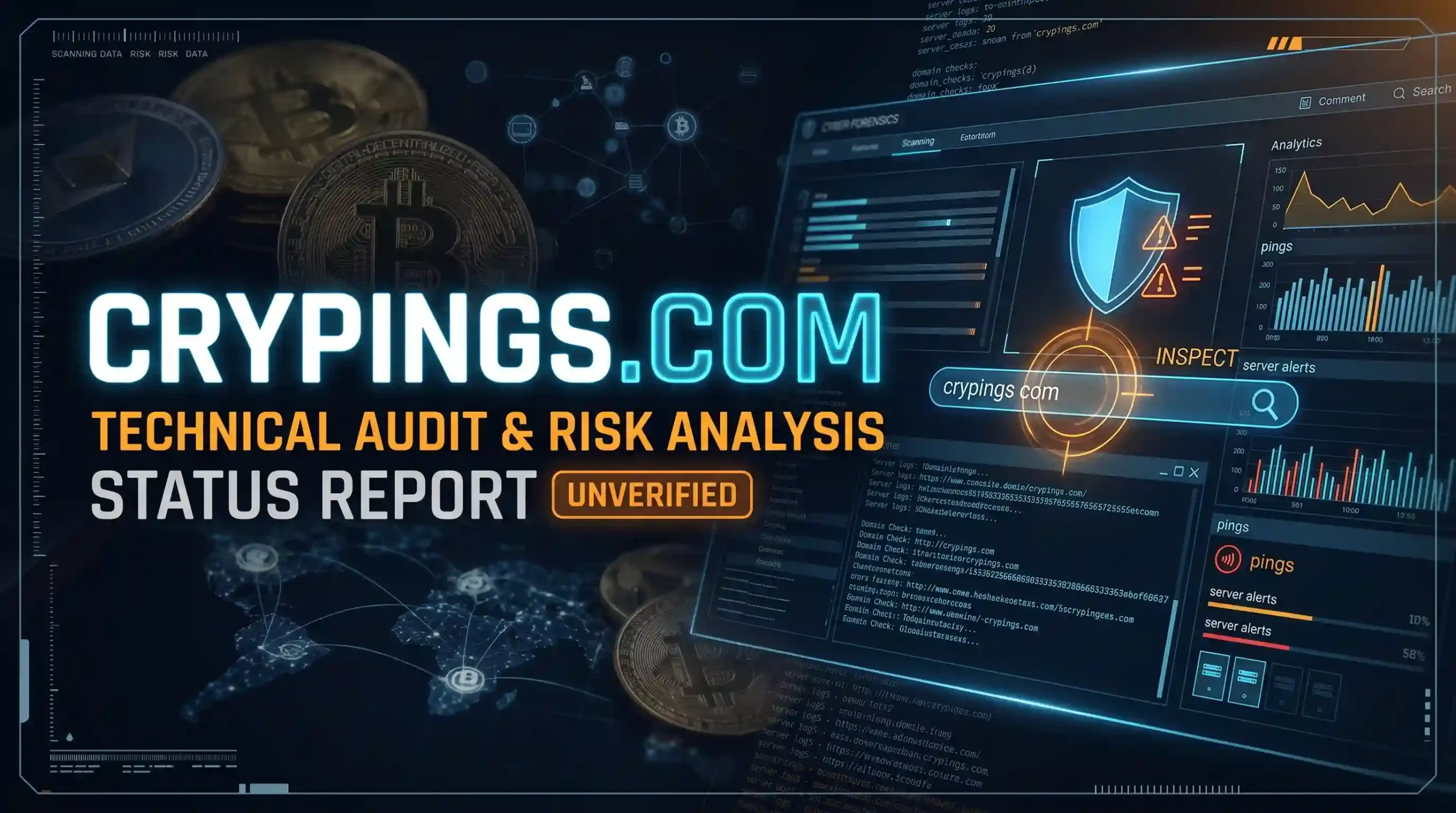
Crypings.com (Crypings Com) Status Report: Technical Audit, Risk Indicators & Verification Guide
Crypings.com (crypings com) is an unverified third-party web domain that lacks registration with primary United States financial and market regulators, including the Securities and Exchange Commission (SEC), the Commodity Futures Trading Commission (CFTC), and the Financial Crimes Enforcement Network (FinCEN). Search volume for the spaced query crypings com typically originates from users investigating links circulated via short-form social media videos,
Telegram signal groups, or third-party referral redirects claiming to offer automated crypto ping alerts, web utilities, or account tools. Because the domain operates without public corporate disclosures, audited smart contracts, or statutory consumer protections, security analysts classify it as a high-risk external destination requiring strict technical isolation prior to interaction.
Users rarely type a domain name with a space instead of a dot by accident. That query pattern happens when people see a watermarked domain name overlaid on an Instagram Reel, YouTube Short, or TikTok clip—or pasted inside a messaging group—and manually search the text to see if the platform actually works. Before entering credentials, granting browser permissions, or linking a Web3 wallet to an unindexed or lightly documented domain, you need verifiable registry records rather than promotional claims.
Crypings.com Entity Snapshot & Verification Matrix
| Verification Dimension | Current Verified Status (October 2026) | Primary Verification Registry | Risk Assessment |
| Domain Identifier | crypings.com (queried as crypings com) |
ICANN RDAP Lookup | Unverified Corporate Ownership |
| U.S. MSB Status | Not listed as a registered Money Services Business | FinCEN MSB Registrant Search | High Regulatory Risk |
| SEC Filing Status | Zero Form D, S-1, or 10-K filings on record | SEC EDGAR Database | Unregistered Entity |
| CFTC Status | Not registered as a CTA, CPO, or FCM | CFTC SmartCheck / RED List | Unregulated Signal/Trading Activity |
| Smart Contract Audit | No published third-party security audit (e.g., Trail of Bits, OpenZeppelin) | Public Audit Repositories | Unverified Code Execution |
| Recommended Action | Do not connect funded wallets, API keys, or personal credentials | FTC Crypto Scam Guidance | Strict Isolation Advised |
Why Searches for “Crypings Com” Spike: Two Distinct Traffic Channels
Investigative analysis of spaced domain queries like crypings com reveals two separate mechanisms driving US search traffic. Understanding which channel brought you to the domain determines the exact security threat you face.
1. Automated Crypto “Ping” and Signal Bots
The name “Crypings” combines crypto and pings—industry shorthand for automated price-action alerts, whale-wallet movement trackers, or arbitrage notification bots. In retail cryptocurrency circles, “ping services” promise real-time alerts when decentralized exchange (DEX) liquidity pools launch, when exchange volume spikes beyond a specific standard deviation, or when specific on-chain wallets execute swaps.
Unregulated ping portals frequently monetize through three vectors:
-
Subscription Paywalls: Charging monthly fees in USDT, USDC, or SOL for access to private Discord or Telegram webhook feeds.
-
Exchange API Key Harvesting: Requesting users to input read/trade API keys from centralized exchanges (such as Coinbase, Kraken, or Binance.US) under the guise of “automated ping execution.”
-
Web3 Wallet Drainers: Prompting visitors to “Verify Wallet Ownership for Free VIP Pings” via an on-chain signature that actually executes a malicious
approve()orPermit2transaction.
2. Viral Social Media Traffic & Ad-Arbitrage Redirects
A second major driver of spaced-domain queries involves viral short-form video marketing. Content creators post 15-second clips demonstrating a sensational capability—free mobile utility tools, unlocked premium apps, or instant crypto faucet payouts—and tell viewers to search Google for a specific two-word phrase like crypings com rather than posting a clickable link that platform spam filters would block.
By forcing the user to search the phrase manually on Google and click the result, the site operator achieves two things. First, they bypass social network link-safety scanners. Second, they send strong organic click-through signals to search engines while routing the visitor onto pages packed with aggressive display ad networks, push-notification opt-in traps, or affiliate CPA (Cost Per Action) survey walls.
Regulatory Verification: Checking Primary U.S. Filings
Any platform offering financial trading signals, custodial wallet tools, or cryptocurrency exchange routing to United States residents falls under strict federal oversight. When evaluating crypings.com, primary government registries provide immediate clarity.
-
FinCEN Money Services Business (MSB) Registry: Under the Bank Secrecy Act, any domestic or foreign entity doing substantial business in the US as a money transmitter or virtual currency administrator must register with the Treasury Department’s Financial Crimes Enforcement Network. Searching the FinCEN MSB State Selector returns no record for Crypings or
crypings.com. -
CFTC Commodity Trading Advisor (CTA) Rules: Under the Commodity Exchange Act, platforms that provide personalized trading signals or automated execution algorithms tied to commodities—including Bitcoin and Ether derivatives—must register with the National Futures Association (NFA) and the CFTC unless a narrow statutory exemption applies. You can verify registration status or check the Registration Deficient (RED) list directly through CFTC Check.
-
SEC EDGAR Disclosures: Legitimate US-facing fintech and digital asset firms raising capital or offering investment contracts file Form D exempt offerings or full registration statements on the SEC EDGAR Company Search portal. No corporate parent tied to
crypings.comappears in EDGAR filings.
The absence of these filings is not a minor paperwork oversight. It means if funds are frozen, API keys are abused, or paid subscriptions vanish overnight, US consumers have zero recourse through SIPC, FDIC, or FINRA arbitration.
Technical Audit Protocol: How to Inspect Crypings.com Safely
Never visit an unverified domain from a browser profile that holds active session cookies or unlocked browser wallet extensions (such as MetaMask, Phantom, Rabby, or Coinbase Wallet). Engineers and security researchers use a five-step command-line and external-lookup workflow to audit a domain without rendering its client-side JavaScript.
Step 1: Query ICANN RDAP for Registration Age and Privacy Proxies
Instead of trusting an “About Us” page that claims years of industry operation, query the Registration Data Access Protocol (RDAP) directly from a terminal or via the ICANN Lookup Portal.
# Query RDAP registration metadata and nameservers without visiting the site
curl -s https://rdap.verisign.com/com/v1/domain/CRYPINGS.COM | jq '{
  domain: .ldhName,
  status: .status,
  events: .events,
  nameservers: [.nameservers[].ldhName]
}'
Inspect the registration and expiration timestamps inside the events array. Short-term registrations (one-year renewals), recent creation dates, or clientHold / redemptionPeriod status codes indicate disposable infrastructure. While privacy-redacted registrant fields (such as Withheld for Privacy or Domains By Proxy) are common for personal blogs, a legitimate financial or SaaS platform handling user funds or API keys should maintain verifiable corporate organization records.
Step 2: Inspect DNS Records and Hosting Infrastructure
Check where the domain routes traffic and whether it configures basic email authentication controls like SPF and DMARC. Disposable domains rarely configure proper mail security records unless they actively send phishing campaigns.
# Check A records, TXT records, and mail servers
dig +nocmd crypings.com A +noall +answer
dig +nocmd crypings.com TXT +noall +answer
dig +nocmd crypings.com MX +noall +answer
Step 3: Verify TLS Certificate Authority Level
A padlock icon in the browser bar only proves that traffic between your browser and the server is encrypted in transit; it says nothing about the legitimacy of the site owner. Over 90% of phishing sites use free, automated Domain Validated (DV) certificates issued by Let’s Encrypt or Cloudflare.
# Inspect TLS certificate issuer and validity window without loading web assets
echo | openssl s_client -servername crypings.com -connect crypings.com:443 2>/dev/null | openssl x509 -noout -issuer -subject -dates
If the output displays a standard DV certificate (CN = R3 or Cloudflare Inc ECC CA) with a 90-day validity window rather than an Organization Validated (OV) or Extended Validation (EV) certificate naming a verifiable legal entity, treat the site as anonymous.
Step 4: Check HTTP Response Headers for Redirect Chains
Ad-arbitrage and phishing portals frequently use HTTP 301 or 302 redirects—or client-side meta http-equiv="refresh" tags—to bounce visitors to secondary domains depending on their IP geolocation or User-Agent string (serving benign content to desktop crawlers while redirecting mobile users to scam pages).
# Trace HTTP redirect chains using a mobile User-Agent string
curl -ILs -A "Mozilla/5.0 (iPhone; CPU iPhone OS 17_0 like Mac OS X)" https://crypings.com | grep -E "^HTTP/|^Location:|^Server:"
Four High-Risk Traps on Unverified Crypto & Utility Portals
If you or a member of your organization have already visited crypings.com or a mirror domain, audit your environment against these four specific technical failure modes.
1. Malicious ERC-20 approve() and Permit2 Signatures
Modern Web3 drainers do not ask for your 12-word seed phrase. Instead, when you click “Connect Wallet” or “Claim Free Access,” the frontend triggers a signature request.
-
The Trap: If the popup requests
SetApprovalForAll,IncreaseAllowance, or an off-chainPermitsignature with an allowance parameter set to115792089237316195423570985008687907853269984665640564039457584007913129639935(uint256max), signing gives the external smart contract permanent authority to empty that token from your wallet at any time. -
The Fix: Immediately open the Etherscan Token Approval Checker (or Revoke.cash), enter your public wallet address, and revoke any unrecognized spending allowances.
2. Exchange API Key Exploitation via Illiquid Pair Wash Trading
Third-party crypto ping and copy-trading websites often instruct users to generate an API key on their primary exchange with “Spot Trading” enabled—reassuring the user that because “Withdrawals” are disabled, their funds cannot be stolen.
-
The Trap: Attackers do not need withdrawal permissions to drain an exchange account. Once they possess a trade-enabled API key, they take a tiny, illiquid micro-cap token pair on the exchange, place massive sell orders from their own accounts at inflated prices, and use your API key to market-buy their worthless orders using your account balance. Your funds transfer to the attacker’s account through the order book in seconds.
-
The Fix: Delete any API keys shared with unverified platforms inside your exchange security dashboard immediately, and restrict all future API keys by explicit IP whitelisting.
3. Browser Push-Notification Hijacking
Content-farm domains promoted on social reels frequently blur out the article or tool behind an overlay reading: “Click ‘Allow’ in the top-left corner to verify you are human and unlock the tool.”
-
The Trap: That prompt is not a CAPTCHA. It is the browser’s native
Notification.requestPermission()API. Once granted, the website can push fake system alerts—such as counterfeit McAfee virus warnings, fake MetaMask security alerts, or bogus crypto deposit notifications—directly onto your desktop or Android lock screen even after you close the browser tab. -
The Fix: In Chrome or Brave, navigate to
chrome://settings/content/notifications, locate the offending domain under Allowed to send notifications, and select Remove.
4. Advance-Fee “Task” or Withdrawal Locks
Some third-party portals display a simulated dashboard showing you have earned rewards, arbitrage profits, or referral bonuses, but halt the withdrawal process with an error code stating your account requires an “on-chain verification deposit,” “gas fee top-up,” or “tax clearance fee.”
-
The Trap: Legitimate blockchain protocols deduct network gas fees directly from the transaction value or use native wallet gas estimation; they never require you to send a separate upfront deposit to a platform address to unlock a withdrawal. The Federal Trade Commission (FTC) explicitly flags upfront fee demands to release funds as a definitive indicator of fraud.
Verified Alternatives to Unregulated Ping & Utility Sites
If you searched for crypings com looking for real-time cryptocurrency market alerts, whale movement pings, or domain network diagnostics, use established platforms with documented corporate ownership, public security audits, and read-only architecture.
| User Requirement | Verified Alternative | Key Security & Architecture Advantage | Cost / Tier Structure |
| Real-Time Price & Technical Pings | TradingView | Server-side webhook, email, and SMS alerts across all major spot and derivatives exchanges; zero wallet connection required. | Free tier available; Paid plans ($12.95–$59.95/mo) |
| On-Chain Whale & Token Alerts | CoinGecko / DexScreener | Direct on-chain indexing across 100+ networks; price and liquidity alerts run via mobile app without token approvals. | 100% Free for core alerting and pair tracking |
| Smart Money & Wallet Tracking | Arkham Intelligence / Nansen | Institutional-grade entity labeling; custom Telegram/Slack webhook pings when specific addresses move assets. | Free tier (Arkham); Institutional tiers for Nansen |
| Network Ping & DNS Diagnostics | Cloudflare Radar / MXToolbox | Enterprise network telemetry, BGP routing checks, and DNS/ping diagnostics without ad-ware redirects. | Free public diagnostic tools |
Frequently Asked Questions
Is crypings.com a legitimate cryptocurrency platform?
No verifiable records exist in US federal financial registries—including FinCEN, the SEC, or the CFTC—confirming crypings.com as a registered cryptocurrency exchange, money transmitter, or regulated commodity trading advisor. Users should treat the domain as an unverified third-party portal and avoid depositing funds or connecting funded Web3 wallets.
Why did I see “crypings com” mentioned in an Instagram Reel or TikTok video?
Creators on short-form video platforms frequently display spaced domain names (such as crypings com without the dot) on screen to bypass automated spam filters that block clickable affiliate or redirect links. When viewers search the exact phrase on Google and click through, the site operator captures high-intent traffic to monetize through display ads, affiliate walls, or lead capture forms.
What should I do if I already connected my crypto wallet to crypings.com?
Simply disconnecting your wallet inside the site interface does not revoke smart contract permissions you may have already signed. If you approved a transaction or signed a token allowance, immediately check your public address on the Etherscan Token Approval Checker and revoke any active permissions. If you entered your 12- or 24-word recovery phrase on the site, your wallet is permanently compromised: create a brand-new wallet with a fresh seed phrase and transfer your remaining assets immediately.
How can I remove spam notifications after visiting crypings.com?
If you clicked “Allow” on a browser popup while visiting the site, open your browser settings and go to Privacy and Security -> Site Settings -> Notifications. Scroll down to the “Allowed to send notifications” list, find the domain entry, click the three-dot menu next to it, and select Block or Remove. Clear your browser cache and site data afterward.
Can a crypto ping service steal funds using a trade-only API key?
Yes. Even when withdrawal permissions are turned off on an exchange API key, malicious operators can drain your balance through wash trading. By using your API key to place market buy orders against their own inflated sell orders on low-liquidity trading pairs, attackers transfer your account value into their own exchange accounts without ever triggering a withdrawal alert.
What do you feel about this post?

Like

Love

Happy

Haha

Sad

Angry

I am an independent writer and digital researcher tracking everyday trends, tech shifts, and modern culture across the US. I focus on cutting through internet noise to bring you crisp, honest stories and practical takeaways you can actually use.