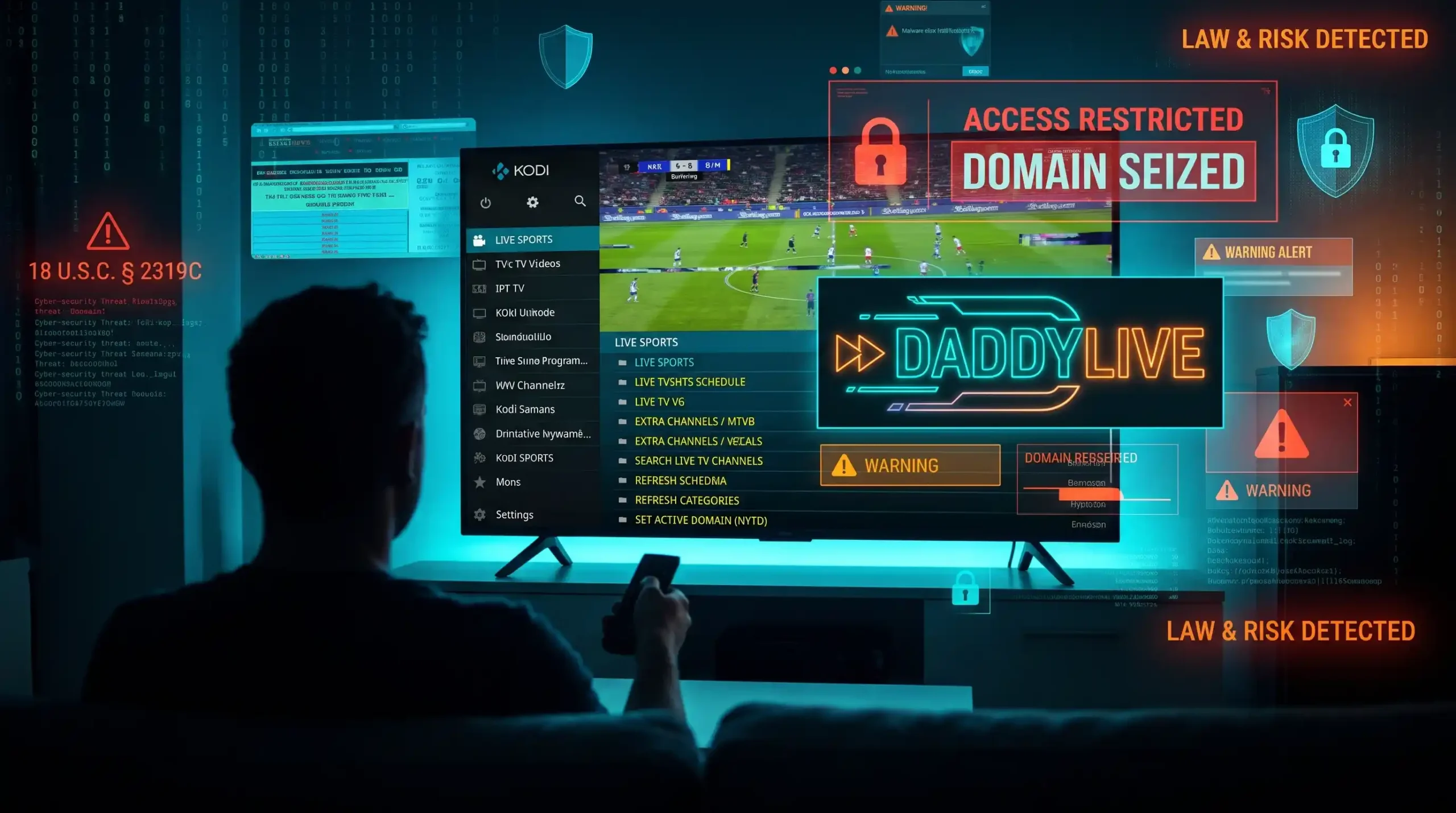
DaddyLive (DaddyLiveHD) Explained: Domain Takedowns, Malware Vectors, and 2026 US Legal Realities
DaddyLive (frequently branded as DaddyLiveHD) is an unlicensed live television and sports streaming aggregator that scrapes and embeds unauthorized broadcast feeds from across the internet. Operating without distribution rights from leagues or networks, the platform relies on rotating mirror domains, high-risk advertising networks, and third-party media player scripts to stay online. For viewers in the United States, accessing DaddyLive introduces immediate exposure to malvertising, unencrypted HTTP traffic, sudden mid-broadcast domain seizures, and potential ISP policy violations.
How the DaddyLive Aggregator Architecture Actually Operates
Unlike licensed multichannel video programming distributors (MVPDs) that ingest high-bitrate satellite or fiber feeds directly from broadcast networks, DaddyLive functions primarily as an indexing and framing layer. According to a May 2026 operational analysis by DigitBin, the platform’s anonymous operators do not produce broadcasts; instead, they aggregate illicitly captured HTTP Live Streaming (HLS) .m3u8 manifest links and wrap them inside browser-based <iframe> players. Behind the consumer-facing web portal, operators also reportedly monetize their infrastructure on a business-to-business basis by reselling raw stream links as backup feeds to paid underground IPTV services.
Users typically encounter the service through two distinct distribution channels, each carrying specific technical failure modes:
-
Rotating Public Web Portals: Because anti-piracy coalitions and copyright holders routinely file takedown notices under Section 512 of the Digital Millennium Copyright Act (DMCA), DaddyLive cannot maintain a permanent web address. The platform cycles through dozens of country-code and generic top-level domains (such as
.dad,.sx,.live, and.mp). When a registrar suspends a domain or an ISP implements a DNS block, traffic is rerouted or abandoned, spawning dozens of copycat phishing domains that mimic the original interface. -
Third-Party Kodi Add-on Scrapers: A large segment of DaddyLive traffic originates from third-party repositories built for the open-source Kodi media center. These Python-based plugins scrape the active DaddyLive web directory and pass the underlying
.m3u8stream URLs to Kodi’sinputstream.adaptiveplayer.
Why Streams Buffer or Break Without Warning
The fragility of this informal pipeline became acute throughout 2025 and 2026. To prevent rival pirate sites and unauthorized Kodi plugins from hotlinking their bandwidth, DaddyLive’s backend servers frequently rotate required HTTP headers, specifically enforcing strict Referer, Origin, and User-Agent validation tokens alongside Cloudflare Turnstile challenges. When the web portal alters its anti-bot configuration or changes its primary domain, third-party Kodi add-ons immediately throw playback errors until volunteer maintainers manually patch the scraper code. Because there is no formal engineering team or SLA, the departure or arrest of a single upstream contributor collapses playback across thousands of connected devices simultaneously.
# Typical HTTP Header Enforcement on Unlicensed HLS Manifests
GET /hls/stream_channel_42/index.m3u8 HTTP/1.1
Host: edge-cdn-node.example.net
User-Agent: Mozilla/5.0 (Windows NT 10.0; Win64; x64)
Referer: https://active-mirror-domain.example/
Origin: https://active-mirror-domain.example
# If Referer or Origin mismatches due to a domain seizure or outdated Kodi scraper,
# the CDN edge returns HTTP 403 Forbidden or a dead redirect.
The Cybersecurity Cost of “Free” Streams
Because unlicensed streaming portals cannot pass the compliance checks required by mainstream ad exchanges like Google AdSense, they monetize traffic through tier-three pop-under networks, aggressive redirect scripts, and unregulated affiliate brokers.
Research by the Digital Citizens Alliance and White Bullet established that advertiser-supported piracy generates $1.34 billion annually, heavily subsidized by fraudulent and malware-laden ad placements. When a user clicks an invisible overlay covering the video player’s “Unmute” or “Fullscreen” button, the browser executes a multi-hop redirect chain that frequently terminates on:
-
Browser Notification Hijacking: Prompts tricking users into granting Chrome or Edge push-notification permissions, which subsequently flood the desktop with fake antivirus renewal alerts.
-
Invalid TLS/SSL Transport: A technical inspection of daddylive.dad on ScamAdviser flagged that the domain lacked a valid SSL certificate and resolved to domain-parking nameservers (
ns1.ag614.parklogic.comandns2.ag614.parklogic.com). Connecting to streaming mirrors without valid TLS encryption exposes browser session data and IP metadata to interception on local networks. -
Trojanized Mobile Clones: DaddyLive does not publish an official mobile application on the Apple App Store or Google Play Store. Every
.apkfile or mobile app marketed under the “DaddyLive” or “DaddyLiveHD” name is an unaffiliated third-party wrapper. Security researchers documented in the Digital Citizens Alliance investigative series have repeatedly found that sideloaded piracy APKs harvest device credentials, inject persistent background adware, or enroll home connections into residential proxy botnets. -
Kodi “Unknown Sources” Privilege Escalation: Installing third-party repositories to access DaddyLive requires toggling on the
Unknown Sourcespermission inside Kodi’s system settings. Once enabled, any compromised third-party repository has automatic update privileges to push arbitrary Python scripts directly onto the host operating system (Windows, Android TV, or Fire OS) without sandboxed store review.
US Statutory Exposure and the 2025–2026 Anti-Piracy Crackdown
A persistent misconception in cord-cutting forums is that streaming unlicensed video operates in a complete legal vacuum in the United States. In reality, US copyright law draws a sharp statutory line between commercial operators and individual end users, though neither group is insulated from consequences.
Operator Felony Liability: 18 U.S.C. § 2319C
Prior to December 2020, a loophole in federal criminal law meant that unauthorized reproduction and distribution (downloading/uploading files) could be prosecuted as a felony, whereas unauthorized public performance (live streaming) was capped as a misdemeanor. Congress closed that gap by enacting the Protecting Lawful Streaming Act of 2020 (codified at 18 U.S.C. § 2319C). Under § 2319C, individuals or groups who willfully provide an illicit digital transmission service to the public for commercial advantage or private financial gain face federal felony charges punishable by up to 10 years in prison for repeat or specialized offenses.
According to the Copyright Alliance analysis of the PLSA, streaming piracy drains over $29 billion annually from the US economy and involves roughly 9 million US broadband households subscribing to or utilizing illicit services. While the statutory text of 18 U.S.C. § 2319C explicitly exempts individual viewers who merely watch an unauthorized HTTP stream from federal felony prosecution, end users still face three concrete vectors of exposure:
-
P2P Swarm Inadvertence: Some unofficial streaming add-ons and backup sports links rely on peer-to-peer protocols (such as AceStream or WebRTC P2P meshes) rather than pure client-server HTTP delivery. The moment a viewer’s client uploads cached video chunks to other peers in the swarm, the viewer crosses from passive reception into unauthorized distribution under 17 U.S.C. § 106, triggering automated DMCA notices and ISP copyright strikes.
-
ISP Acceptable Use Policy (AUP) Enforcement: Major US broadband providers maintain contractual authority to throttle, suspend, or terminate accounts flagged for repeated copyright infringement or botnet-related proxy traffic originating from compromised streaming boxes.
-
Sudden Infrastructure Collapse: Global enforcement against live sports piracy accelerated sharply between late 2025 and mid-2026. As detailed in the University of Cincinnati Intellectual Property and Computer Law Journal (May 2026), the Alliance for Creativity and Entertainment (ACE), backed by Amazon, Apple TV, Netflix, Paramount Global, Disney, and Warner Bros. Discovery, coordinated with Egyptian authorities in September 2025 to dismantle Streameast, which had accumulated 1.6 billion visits across more than 80 domains. On July 21, 2026, an Egyptian court convicted the Streameast operators in a landmark criminal case, following a similar joint ACE and DAZN shutdown of the Calcio sports piracy ring. US lawmakers and legal scholars are simultaneously advancing proposals for judicial live-blocking injunctions, already active in ten countries, to cut off foreign pirate sports domains in real time during live games.
2026 Licensed US Live Sports Streaming Alternatives
For viewers who refuse to troubleshoot broken Kodi scrapers, expose home networks to unencrypted adware domains, or lose a broadcast during the fourth quarter of an NFL or NBA game, licensed vMVPDs (virtual multichannel video programming distributors) provide guaranteed uptime, 1080p60/4K HDR bitrates, and cloud DVR storage.
Note on Pricing Discrepancies: Published rates across consumer technology trackers show minor variations in 2026 due to promotional tiers vs. standard base rates. For example, American TV’s 2026 comparison lists promotional or older grandfathered pricing (such as YouTube TV at $72.99/mo and Fubo Pro at $79.99/mo), whereas updated Q3/Q4 2026 audits by CNET (October 2026) and Cord Cutters News (July 2026) verify the current standard monthly base rates reflected below.
| Platform | Verified Q3/Q4 2026 Base Price | Channel Count | Core Sports Strengths | Critical Trade-Offs & Dealbreakers |
| YouTube TV | $82.99 / mo | 100+ channels | Full local broadcast networks (ABC, CBS, FOX, NBC), ESPN, NFL Network, and exclusive NFL Sunday Ticket integration. | Lacks most Regional Sports Networks (RSNs like Bally/FanDuel Sports Network) required for local MLB, NBA, and NHL blackout games. |
| Fubo (Pro Plan) | $88.99 / mo | 212 channels | Includes ESPN Unlimited and broad Regional Sports Network (RSN) coverage plus international soccer. | Major Gap: Excludes NBC local stations and NBC Sports RSNs in current carriage breakdowns, plus incurs mandatory monthly RSN regional fees. |
| DIRECTV (Choice) | $94.99 / mo (Base Entertainment at $89.99/mo) | 125+ channels | The most complete single-subscription sports lineup, combining national networks, ESPN Unlimited, and local RSNs. | Highest monthly cost; upgrading to the Ultimate tier pushes the bill to $124.99/mo. |
| Sling TV (Orange / Blue) | $45.99 / mo ($60.99/mo combined) | 30 to 50+ channels | Lowest entry cost for legal ESPN access (Sling Orange) or FOX/NBC market-dependent access (Sling Blue). | Sling Orange restricts streaming to a single device stream at a time and omits CBS entirely (requiring Paramount+ or an OTA antenna). |
Disqualification & Decision Framework: Which Route Fits Your Setup?
-
Skip Fubo Pro if your primary viewing revolves around Sunday Night Football, Premier League matches on USA/NBC, or NBA/NHL playoff series carried on TNT and TBS. YouTube TV ($82.99/mo) or Hulu + Live TV ($100/mo standard) covers those national broadcast rights without hidden RSN surcharges.
-
Skip YouTube TV if you watch 80+ local regular-season MLB, NBA, or NHL games per year. Unless your local team offers a direct-to-consumer streaming pass, DIRECTV’s Choice Plan ($94.99/mo) is the primary vMVPD that bundles both national channels and local RSNs in one guide.
-
Cut Monthly Subscription Costs Legally: Before paying $83+ per month for a bloated channel bundle, connect a $30 flat UHF/VHF digital antenna to your television’s coaxial tuner. Over-the-air (OTA) broadcasts deliver uncompressed 1080i/720p (and ATSC 3.0 4K in supported US metro areas) for every local NFL game on CBS and FOX, plus network events on ABC and NBC, with zero latency and zero monthly cost. Pair an OTA antenna with Sling Orange ($45.99/mo) during football or basketball season and cancel immediately when the season ends.
What do you feel about this post?

Like

Love

Happy

Haha

Sad

Angry

I am an independent writer and digital researcher tracking everyday trends, tech shifts, and modern culture across the US. I focus on cutting through internet noise to bring you crisp, honest stories and practical takeaways you can actually use.