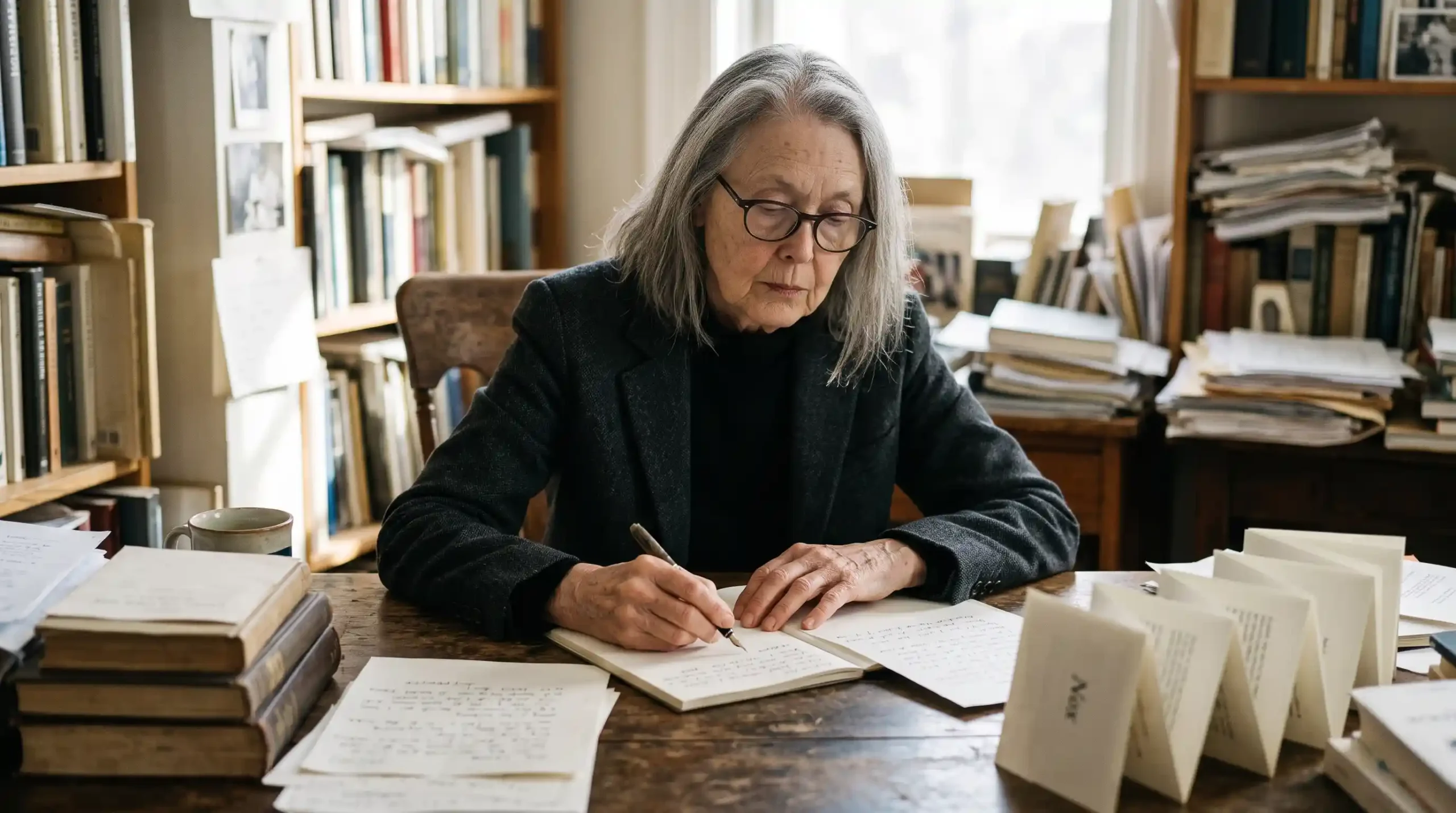
Anne Carson is a Canadian poet, essayist, translator, and classicist known for dismantling traditional boundaries between genres. Her work blends ancient Greek scholarship with modern verse, personal grief, and dry humor across landmark titles like Autobiography of Red and Nox.
Quick Facts
- Born: June 23, 1950 (Toronto, Ontario, Canada)
- Education: University of Toronto (B.A., 1974; M.A., 1975; Ph.D., 1981)
- Primary Genres: Poetry, lyric essay, classical translation, verse drama
- Notable Works: Eros the Bittersweet (1986), Glass, Irony and God (1995), Autobiography of Red (1998), The Beauty of the Husband (2001), If Not, Winter: Fragments of Sappho (2002), Nox (2010), Wrong Norma (2024)
- Major Honors: MacArthur Fellowship (2000), T. S. Eliot Prize (2001), Griffin Poetry Prize (2001, 2014), Princess of Asturias Award for Literature (2020), PEN/Nabokov Award (2021)
- Collaborator: Robert Currie
Early Life and the Discovery of Ancient Greek
Anne Carson was born in Toronto on June 23, 1950. Because her father worked as a bank manager, her childhood was defined by frequent moves among small towns across Ontario, including Port Hope and Hamilton. She grew up observant and bookish, feeling somewhat outside the routines of the communities where her family lived.
Her intellectual direction changed during high school. In a local bookstore, Carson stumbled across an edition of Sappho’s poetry printed with ancient Greek on one side and an English translation on the other. Captivated by the visual structure and mystery of the original language, she approached her high school Latin teacher, Alice Cowan. Cowan agreed to teach her ancient Greek during lunch periods. That informal tutorial laid the foundation for Carson’s dual path as an academic scholar and a writer.
Carson enrolled at St. Michael’s College at the University of Toronto. Her time there was not conventional. Frustrated by the constraints of academic bureaucracy, she dropped out twice to work in commercial graphic design and advertising. She ultimately returned, completing her Bachelor of Arts in 1974, her Master of Arts in 1975, and her Ph.D. in Classics in 1981. Her doctoral dissertation investigated the concept of desire in ancient Greek poetry, focusing especially on Sappho.
Academic Career and Classical Scholarship
After completing her doctorate and studying Greek metrics at the University of St Andrews in Scotland, Carson established a career in academia. She taught ancient Greek language, literature, and culture for decades at institutions including McGill University in Montreal, the University of Michigan, Princeton University, and New York University.
Her academic training gave her a unique relationship with language. Rather than treating ancient Greek as a dead artifact, she viewed it as an active system for thinking through contemporary emotional dilemmas.
In 1986, Princeton University Press published her first book, Eros the Bittersweet. Adapted from her doctoral research, the book examines how early Greek poets understood romantic longing. Carson focused on the word glukupikron (“sweetbitter”), coined by Sappho to describe the dual nature of love.
She argued that desire depends on distance: love requires a three-part dynamic involving the lover, the beloved, and the space or obstacle between them. The book also explored how the invention of the phonetic alphabet changed human perception, memory, and interior life. Eros the Bittersweet remains a cornerstone text in classical reception, praised equally by literary theorists and general readers for its clarity, humor, and philosophical depth.
Breakthrough Works: Poetry and Hybrid Verse
During the 1990s, Carson transitioned from scholarly circles into mainstream literary prominence by publishing works that refused to fit into a single category.
Glass, Irony and God (1995)
This collection announced Carson’s distinct poetic voice to a broader public. Its opening piece, “The Glass Essay,” is an autobiographical long poem that recounts the emotional aftermath of a failed romantic relationship.
The narrator retreats to her mother’s home in rural Ontario, enduring physical loneliness while reading the journals and novels of Emily Brontë. Carson weaves together weather reports, Brontë’s mystical visions, and candid self-examination. The poem established her signature technique: placing historical figures in conversation with modern domestic life.
Autobiography of Red (1998)
Subtitled A Novel in Verse, this work became Carson’s most celebrated and accessible book. It draws inspiration from surviving fragments by the ancient Greek lyric poet Stesichoros, who wrote about the myth of Geryon—a red-winged monster slain by Herakles during his tenth labor.
Carson transposes the myth into a twentieth-century coming-of-age story. Her Geryon is a quiet, sensitive boy who wears red wings, loves photography, and suffers emotional cruelty at home. As a young man, he falls into a painful romance with Herakles, an older boy who leaves him heartbroken. The narrative follows Geryon across North America and to the volcanic landscapes of South America as he seeks emotional autonomy. Autobiography of Red earned widespread acclaim, selling hundreds of thousands of copies—an unusual feat for a book composed in verse.
The Beauty of the Husband (2001)
Carson followed that success with The Beauty of the Husband: A Fictional Essay in 29 Tangos. The book chronicles the slow collapse of a marriage marked by infidelity, deception, and lingering attraction.
Each section corresponds to a step in a tango, reflecting the tension and choreographed cruelty between the spouses. In 2001, the book won the T. S. Eliot Prize. Carson was the first woman to receive the British award since its founding in 1993.
Notable Works and Key Themes
| Title | Year | Form / Genre | Core Subject Matter |
| Eros the Bittersweet | 1986 | Scholarly essay | The triangular mechanics of desire and the impact of the alphabet |
| Glass, Irony and God | 1995 | Mixed poetry and prose | Heartbreak, solitude, and Emily Brontë’s spiritual intensity |
| Autobiography of Red | 1998 | Verse novel | Mythological reimagining of the monster Geryon as an outcast artist |
| Men in the Off Hours | 2000 | Poetry and essays | Encounters between historical figures (St. Augustine, Virginia Woolf) |
| The Beauty of the Husband | 2001 | Narrative poem | The dissolution of a marriage and the dangerous allure of beauty |
| If Not, Winter | 2002 | Translation | Restored fragments of Sappho with parallel Greek text |
| Nox | 2010 | Artists’ book / Elegy | The death of her estranged brother and an analysis of Catullus 101 |
| Float | 2016 | Unbound chapbooks | Chance, performance, and cross-genre meditations |
| Wrong Norma | 2024 | Collection of prose pieces | Modern culture, swimming, anxiety, and historical vignettes |
Translation as an Artistic Practice
Carson approaches translation not as a mechanical transfer of meaning, but as a dynamic creative act. Her work with Greek texts is noted for its directness and refusal to smooth away historical strangeness.
Her 2002 volume, If Not, Winter: Fragments of Sappho, presents the surviving Greek text on left-hand pages facing Carson’s English translations on the right. Rather than inventing phrases to bridge missing words in damaged papyrus fragments, Carson used square brackets to indicate physical gaps in the historical record. The silent spaces become an integral part of the reading experience, emphasizing both what remains of Sappho’s voice and what has been lost to time.
Carson has also produced translations of classical tragedy:
- Euripides: Grief Lessons: Four Plays by Euripides (2006) captures the playwright’s dark irony and moral outrage.
- Sophocles: Antigonick (2012), a translation of Antigone featuring hand-lettered text and illustrations by Bianca Stone, highlights the urgency of ethical defiance.
- Aeschylus: An Oresteia (2009) combines works by Aeschylus, Sophocles, and Euripides into a single dramatic cycle tracking the evolution of ancient vengeance and justice.
Grief and Materiality: The Creation of Nox
In 2000, Carson’s older brother, Michael, died suddenly in Denmark. The two had been estranged for two decades. In the late 1970s, Michael fled Canada to avoid a prison sentence on drug charges, living under assumed identities across Europe and communicating with his family through rare, unpredictable phone calls.
Carson spent a decade processing his life and death. The result was Nox, published by New Directions in 2010.
Nox is not bound like a traditional book. It comes in a sturdy gray slipcase containing a single, continuous sheet of accordion-folded paper that unfolds into a long frieze. The work is a visual reproduction of a scrapbook Carson made by hand. It contains:
- Faded family snapshots of Michael as a boy
- Fragments of his handwritten letters
- Collaged postage stamps and travel documents
- Carson’s personal recollections of their childhood
- A systematic, word-by-word translation and commentary on Poem 101 by the Roman poet Catullus, written for his own dead brother
By forcing the reader to physically unfold the paper, Nox turns reading into an encounter with grief, loss, and the limits of biographical knowledge.
Artistic Collaboration and Performance
Carson has long resisted the solitary image of the poet. Much of her later work has developed through collaborations with her partner, Robert Currie, whom she often refers to in programs as “the Random Man.”
Currie, an artist and former commercial printer, collaborates on the visual design, typography, and physical structure of her books. Together, they have produced performance pieces, staged readings, and multimedia presentations that involve dancers, actors, and unrehearsed public participants.
This spirit of experimentation is visible in Float (2016). The collection consists of 22 individual chapbooks housed inside a clear plastic slipcase. The pamphlets can be pulled out and read in any random order, leaving the structure of the book up to the reader.
Literary Style and Critical Impact
Carson’s work stands out in contemporary literature because of several distinct qualities:
- Collage of Eras: She moves effortlessly between classical antiquity and modern life. A single piece might reference Homer, Gertrude Stein, television commercials, and ice fishing in northern Canada.
- Emotional Restraint: Carson rarely indulges in sentimentality. She discusses pain, betrayal, and longing with forensic detachment, which gives her poems their emotional resonance.
- Typographic Awareness: She treats punctuation, white space, and book design as narrative tools. A bracket or a blank half-page carries as much weight as a stanza.
- Philosophical Wit: Her writing carries an understated, deadpan humor that keeps her classical scholarship accessible and engaging.
Critics and readers frequently consider Carson a perennial contender for the Nobel Prize in Literature. Her influence spans far beyond poetry, shaping contemporary essayists, visual artists, and translators who treat genre as a starting point rather than a fence. Carson avoids literary celebrity, rarely grants formal interviews, and lives quietly, preferring that readers encounter her through the pages and objects she makes.
FAQs
What is Anne Carson’s most famous book?
Anne Carson’s most famous book is Autobiography of Red (1998), a novel in verse that reimagines the ancient Greek myth of the winged monster Geryon as a modern boy navigating art, love, and heartbreak.
What awards has Anne Carson won?
Carson has won several major literary prizes, including the MacArthur Fellowship “genius grant” (2000), the T. S. Eliot Prize (2001), the Griffin Poetry Prize (2001 and 2014), the Princess of Asturias Award for Literature (2020), and the PEN/Nabokov Award for Achievement in International Literature (2021).
What is Anne Carson’s book Nox about?
Nox (2010) is an elegy for Carson’s brother, Michael, who died unexpectedly after years of estrangement. Housed in a gray box with an accordion-folded page, the book combines family photographs, fragments of letters, dictionary entries, and reflections on Catullus’s Poem 101.
Where did Anne Carson teach?
Carson has taught Classics, comparative literature, and creative writing at several universities, including McGill University, the University of Michigan, Princeton University, Emory University, and New York University.
Is Anne Carson a poet or a classicist?
Anne Carson is both. She holds a Ph.D. in Classics from the University of Toronto and spent decades teaching ancient Greek language and literature, while also publishing widely acclaimed poetry, translations, and hybrid essays.\
Source list
- Poetry Foundation: Anne Carson Biography, October 2026
- MacArthur Foundation: Anne Carson: MacArthur Fellows Program, October 2026
- Griffin Poetry Prize: Anne Carson: Griffin Poetry Prize Profile, October 2026
- Princess of Asturias Foundation: Anne Carson: Princess of Asturias Award for Literature 2020, October 2026
- The Paris Review: Anne Carson, The Art of Poetry No. 88, October 2026
What do you feel about this post?

Like

Love

Happy

Haha

Sad

Angry

I am an independent writer and digital researcher tracking everyday trends, tech shifts, and modern culture across the US. I focus on cutting through internet noise to bring you crisp, honest stories and practical takeaways you can actually use.