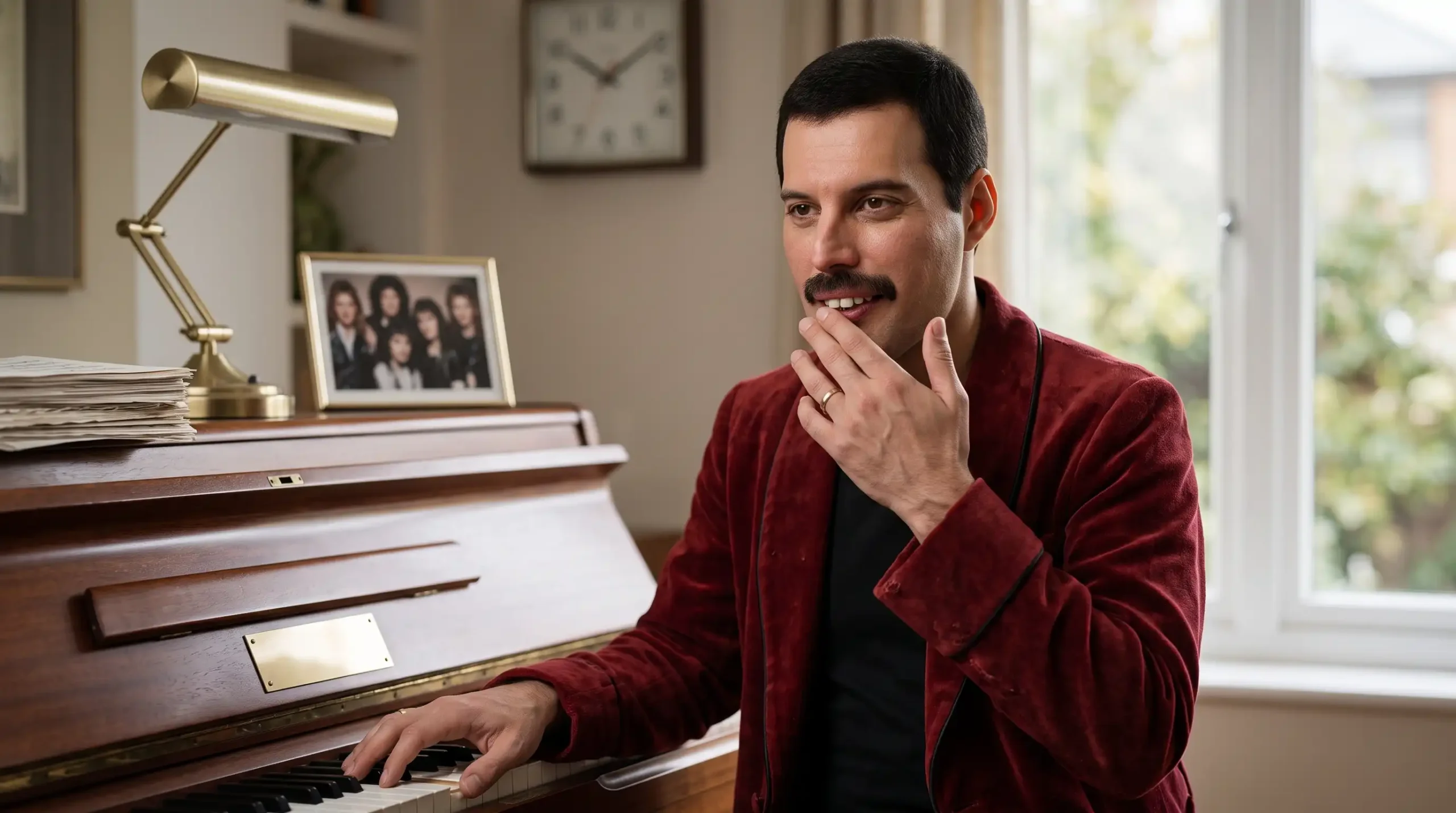
Freddie Mercury was widely reported to have four extra teeth in his upper mouth, which contributed to his prominent front teeth and distinctive smile. He reportedly chose not to correct them because he feared changing his mouth could affect his voice.
Quick Facts
| Question | Answer |
|---|---|
| Did Freddie Mercury have extra teeth? | He was widely reported to have four additional teeth in the upper jaw. |
| How did they look? | They helped create a pronounced forward projection of his upper front teeth. |
| Did he fix his teeth? | There is no well-documented public evidence that he had the distinctive alignment permanently corrected. |
| Why did he keep them? | Accounts from people close to him say he worried dental changes could affect his voice. |
| Did his teeth give him a four-octave voice? | There is no scientific evidence establishing that his teeth caused his vocal range. |
| Did Rami Malek wear fake teeth? | Yes. He wore custom prosthetic teeth to portray Mercury in Bohemian Rhapsody. |
What Was Different About Freddie Mercury’s Teeth?
The familiar story is that Mercury had four extra upper teeth. Those additional teeth were said to take up space in the upper jaw, pushing the visible front teeth forward and producing the crowded, prominent smile audiences recognized.
This explanation appears repeatedly in biographies and reporting about Mercury, including coverage of Bohemian Rhapsody. However, there is an important distinction between a widely repeated biographical detail and a documented dental diagnosis: Mercury’s personal dental records were not publicly available. A 2021 paper in Dental Cadmos specifically examined the claim about his supposed four additional incisors by studying original photographs and videos, showing that the detail deserves more caution than the popular version usually receives.
That means it is reasonable to say Mercury was widely reported to have four extra upper teeth, but treating “36 teeth” as a clinically documented fact goes further than the available public evidence allows.
Overbite or Overjet?
People usually describe Mercury’s smile as an overbite, but the terminology can be more precise.
An overbite generally refers to the vertical overlap of the upper front teeth over the lower teeth. Mercury’s most obvious feature in photographs was the way his upper front teeth projected forward. Dentists and orthodontic discussions of his appearance have therefore also used terms such as overjet and Class II malocclusion.
Because Mercury was never examined publicly through a complete modern orthodontic record, it is better not to assign a precise clinical diagnosis or measurement from photographs alone.
Why Did Freddie Mercury Never Fix His Teeth?
This is probably the question most people have after seeing his distinctive smile.
According to filmmaker Rudi Dolezal, who worked closely with Mercury’s story, the singer was afraid that changing his teeth would change the way his voice sounded. Dolezal described Mercury as caring more about his voice than his appearance. NPR has preserved the same account in reporting about Mercury.
Peter Freestone, Mercury’s personal assistant for more than a decade, also recalled how self-conscious Mercury could be about his teeth. Freestone said Mercury often used his upper lip or hand to cover them during interviews, while at home he was much less concerned about hiding his smile.
That combination is what makes the story interesting. Mercury apparently disliked the appearance of his teeth, yet he was reluctant to alter them because his voice was central to his identity and career.
There is no strong public record showing that he underwent orthodontic correction, extraction of the reported extra teeth, veneers, or another permanent cosmetic procedure that changed the feature. The famous alignment remained visible throughout his career.
Did Freddie Mercury’s Teeth Actually Give Him His Incredible Voice?
This is where the popular story needs some separation from the science.
The idea that his extra teeth gave him “more space” and therefore a greater vocal range became famous partly through Bohemian Rhapsody. In the film, Mercury tells Brian May and Roger Taylor that he was born with four additional incisors and suggests that the extra space contributes to his range. The line is based on the long-running story surrounding his teeth, but it should not be treated as scientific proof.
Researchers have actually studied Mercury’s voice. A peer-reviewed acoustic study published in Logopedics Phoniatrics Vocology analyzed recordings of Mercury and estimated his observed singing range at 37 semitones, from F♯2 to G5 in the analyzed material. The researchers also examined his unusually rapid and irregular vibrato and investigated subharmonic phonation using high-speed imaging of another singer imitating the relevant vocal behavior.
The study did not establish that Mercury’s teeth created his vocal range.
That distinction matters. Teeth, tongue, palate, jaw position and the rest of the vocal tract can influence articulation and resonance, so it is not unreasonable to think that changing the shape of someone’s mouth could change how singing feels or sounds. But there is no experimental evidence demonstrating that Mercury’s four reported extra teeth were responsible for his remarkable vocal ability.
In other words, the connection between his teeth and his voice is best described as a belief associated with Mercury and his biographical story, not a proven scientific explanation for his singing.
Was Freddie Mercury Self-Conscious About His Smile?
Yes, accounts from people who knew him suggest that he was.
Freestone’s recollections are particularly useful because they distinguish between Mercury’s public and private behavior. During interviews, Mercury sometimes tried to conceal his teeth with his lip or hand. In private settings, Freestone remembered him laughing freely without the same concern.
This detail also helps explain why photographs can give two very different impressions of Mercury. In some pictures, his mouth is relatively controlled and his upper lip covers much of the front teeth. In others, especially when he was laughing or performing, the full shape of his smile is obvious.
His mustache also became an important part of his appearance. It did not hide the teeth completely, but it changed the visual balance of his mouth and face and eventually became one of his most recognizable style choices.
What Happened to His Teeth in Bohemian Rhapsody?
Rami Malek wore specially made prosthetic teeth to portray Mercury in the 2018 film Bohemian Rhapsody.
The prosthetics were created by dental technician Chris Lyons. In an interview with The Irish Times, Lyons explained that the teeth were custom-made to push Malek’s upper lip forward and reproduce the visual effect of Mercury’s prominent teeth. The production used different sizes because a literal reproduction of Mercury’s proportions would not have looked natural on Malek.
Malek also discussed the experience in an NPR interview. He said the prosthetic teeth were difficult to get used to at first and that wearing them helped him understand why Mercury’s habit of covering his mouth was such an important physical detail for the performance.
So the teeth seen in the movie were prosthetics, not Malek naturally having the same dental structure.
Could Modern Dentistry Have Fixed Freddie Mercury’s Teeth?
Modern orthodontics can treat many forms of crowding, excessive overjet and malocclusion, but it would be misleading to say exactly what treatment Mercury would have needed without examining him.
A person with extra teeth may require imaging to determine their location, orientation and relationship to the roots of neighboring teeth. Treatment can differ significantly depending on whether extra teeth are erupted, impacted, causing crowding, blocking other teeth or simply present without symptoms.
The same principle applies to an overjet. Treatment decisions can involve orthodontics, extraction, restorative dentistry, jaw surgery or combinations of these approaches, depending on the actual anatomy and functional problems.
For Mercury specifically, the lack of publicly available dental records means modern dentists can discuss what might have been possible, but they cannot responsibly reconstruct his exact treatment plan from photographs alone.
How Many Teeth Did Freddie Mercury Have?
The commonly repeated answer is 36 teeth — 32 normal adult teeth plus four additional teeth.
However, that number should be described as a widely reported claim rather than an independently verified figure from Mercury’s dental records. The four-extra-teeth story is deeply embedded in biographies, media coverage and the Bohemian Rhapsody narrative, while the 2021 orthodontic paper shows that the underlying anatomy has been questioned and investigated rather than conclusively documented in the public record.
That is an important difference between saying “Mercury was reported to have 36 teeth” and saying “medical records prove Mercury had exactly 36 teeth.”
Why Freddie Mercury’s Teeth Became Part of His Legacy
Mercury’s teeth were unusual, but their lasting importance came from what they represented.
He did not have the perfectly uniform celebrity smile that later became common in entertainment. Instead, his appearance remained distinctive enough that audiences could recognize him immediately. The feature he reportedly felt insecure about eventually became inseparable from the image of Queen’s frontman.
There is also an irony in the story. The same teeth Mercury reportedly wanted to hide became something Rami Malek had to reproduce deliberately for a major film role.
The evidence supports a simple conclusion: Freddie Mercury’s teeth were a genuine and highly distinctive feature of his appearance, but the claim that they created his extraordinary singing voice remains unproven. His reluctance to alter them appears to have been closely tied to his fear of changing his sound, while the scientific study of his singing points toward complex vocal behavior rather than a simple dental explanation.
FAQs
Did Freddie Mercury really have four extra teeth?
Freddie Mercury was widely reported to have four additional teeth in his upper mouth. However, his personal dental records were not publicly available, and a 2021 Dental Cadmos paper specifically examined the accuracy of the four-extra-incisors claim using photographs and videos.
Why did Freddie Mercury not fix his teeth?
Accounts from people familiar with Mercury say he was worried that changing his teeth could alter his voice. Rudi Dolezal said Mercury valued his voice more than his appearance, while Peter Freestone recalled that Mercury was self-conscious about his teeth.
Did Freddie Mercury’s teeth give him a four-octave voice?
There is no scientific evidence showing that his teeth caused his vocal range. A peer-reviewed study analyzed Mercury’s recordings and found a measured singing range of 37 semitones while also identifying distinctive vocal behaviors, but it did not link his range to his dental structure.
Did Rami Malek wear fake teeth as Freddie Mercury?
Yes. Rami Malek wore custom prosthetic teeth created for Bohemian Rhapsody. The dental technician Chris Lyons designed them to reproduce the forward projection associated with Mercury’s smile.
Source list
- PubMed: Freddie Mercury-acoustic analysis of speaking fundamental frequency, vibrato, and subharmonics, Access Date: September 19, 2026
- NPR: ‘You Better Own This’: How Rami Malek Came To Embody Freddie Mercury, Access Date: September 19, 2026
- TIME: The True Story Behind ‘Bohemian Rhapsody’, Access Date: September 19, 2026
- Dental Cadmos: La leggenda sui denti di Freddie Mercury: e se non avesse avuto i quattro incisivi in più?, Access Date: September 19, 2026
- uDiscover Music: Freddie Mercury’s Munich Years: An Interview With Phoebe Freestone, Access Date: September 19, 2026
- The Irish Times: Freddie Mercury’s teeth in ‘Bohemian Rhapsody’? Meet their maker, Access Date: September 19, 2026
What do you feel about this post?

Like

Love

Happy

Haha

Sad

Angry

I am an independent writer and digital researcher tracking everyday trends, tech shifts, and modern culture across the US. I focus on cutting through internet noise to bring you crisp, honest stories and practical takeaways you can actually use.