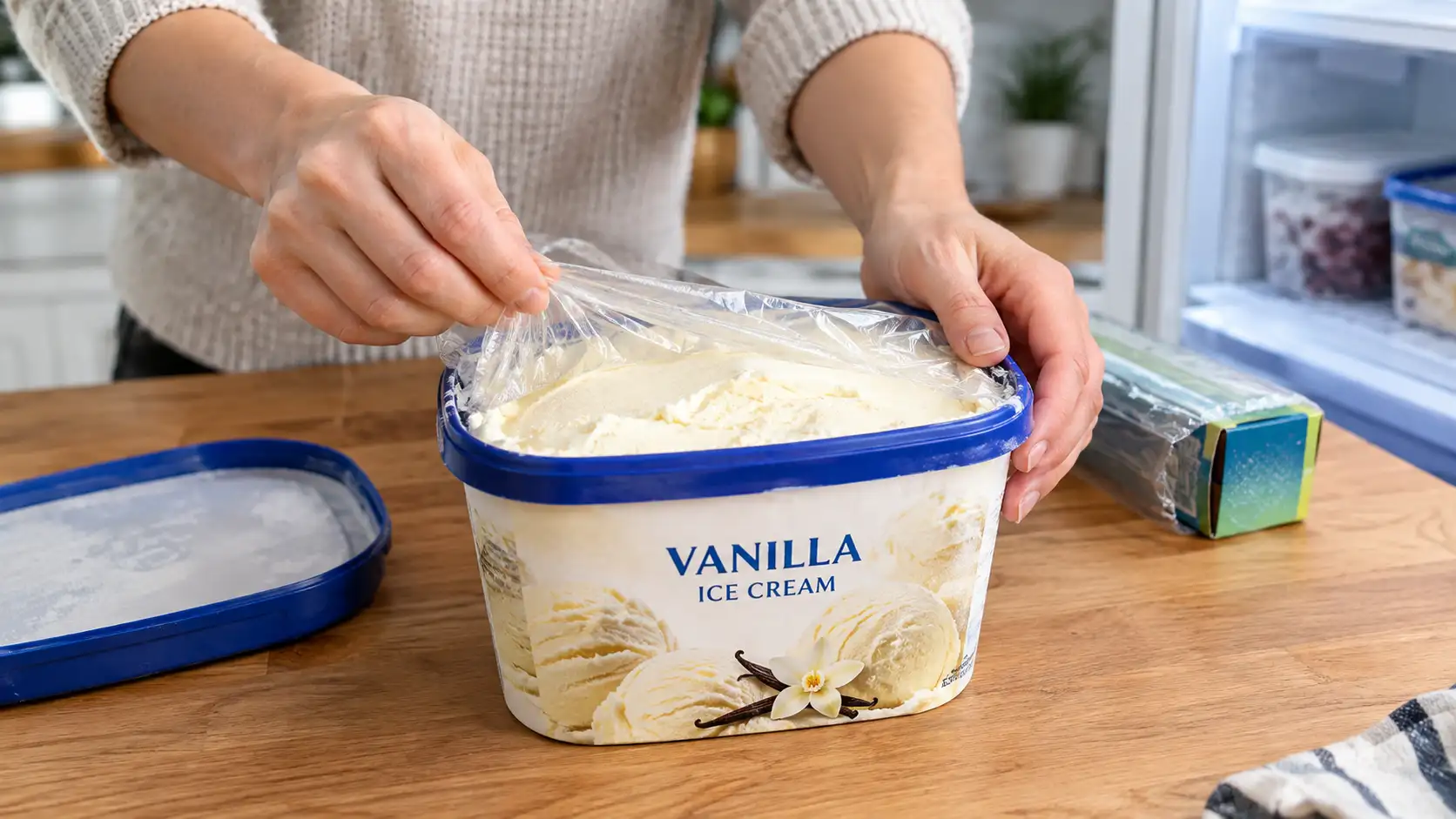
The best way to prevent freezer burn on ice cream is to limit air exposure, keep the container tightly sealed, and store it at a steady 0°F (-18°C) or colder. Avoid repeated thawing and refreezing, too.
Key Takeaways
- Press freezer-safe plastic wrap or wax paper directly against the ice cream before replacing the lid.
- Store the tub in the back or center of the freezer rather than the door.
- Keep the freezer at 0°F (-18°C) or below and avoid temperature swings.
- Scoop what you need and return the container promptly.
- Freezer burn is mainly a quality problem. It can make ice cream dry, icy, grainy, or stale.
What Causes Freezer Burn on Ice Cream?
Freezer burn is essentially moisture loss from the surface of frozen food. When that surface is poorly protected, moisture escapes and leaves behind a dry, icy layer. University of Minnesota Extension recommends airtight packaging and minimizing air contact to reduce freezer burn.
Ice cream has another problem: its creamy texture depends on very small ice crystals. When it warms and freezes again, those crystals can grow larger, making the texture coarse or grainy. Temperature fluctuations are a known cause of larger ice crystals in frozen foods.
That is why freezer burn often comes from a combination of an exposed surface, loose packaging, temperature changes, and too much time in storage.
1. Press Plastic Wrap Against the Surface
For an opened tub, this is one of the easiest fixes.
Place freezer-safe plastic wrap or wax paper directly on the ice cream surface, smoothing it down so there is as little trapped air as practical. Then replace the lid tightly. Food experts cited by Epicurious and The Kitchn recommend this method because it reduces direct exposure to freezer air.
This becomes especially useful as the tub gets emptier. More empty space means more air above the exposed ice cream.
You do not need to flatten or compress the ice cream. The aim is simply to create a close-fitting barrier over the surface.
2. Make Sure the Lid Seals Properly
A container can look closed while still allowing air inside.
Before replacing the lid, wipe ice cream from the rim so it can sit evenly. Check for cracks, warped plastic, or a loose fit. If the original container no longer closes securely, move the ice cream to a clean, freezer-safe airtight container.
USDA guidance recommends tight wrapping and freezer-safe materials to keep air out and protect frozen foods from freezer burn.
For a normal store-bought pint, transferring it is usually unnecessary while the original lid still seals well.
3. Keep the Freezer at 0°F or Colder
Temperature control matters just as much as packaging.
FoodSafety.gov says freezer storage at 0°F (-18°C) or below is suitable for keeping frozen foods continuously frozen, with its freezer time limits focused on quality rather than safety. USDA guidance also recommends 0°F or lower for frozen-food storage.
For ice cream, a stable temperature is especially important. Repeated warming and cooling allows ice crystals to grow, which can make the dessert gritty. Breyers recommends storing ice cream at 0°F (-18°C) or colder and keeping the temperature steady.
A small freezer thermometer can help confirm the actual temperature rather than relying only on the appliance dial.
4. Keep Ice Cream Out of the Freezer Door
The door is one of the warmer, more frequently changing areas of a freezer.
Every opening lets warmer air enter, so ice cream stored there can experience more temperature variation. Practical ice-cream storage guidance from Epicurious and The Kitchn recommends keeping it toward the back or center instead.
Your freezer may have its own cold spots, so the general rule is to choose a cold, stable area and avoid the door.
5. Minimize Thawing and Refreezing
A short time on the counter while you scoop is not the main concern. The bigger problem is allowing the tub to soften substantially and repeatedly putting it back in the freezer.
During thawing, some ice melts. When it freezes again, the water can form larger crystals, damaging the smooth texture.
Scoop what you need, close the lid, and return the container promptly.
There is also a food-safety consideration. University of Minnesota Extension specifically advises against refreezing ice cream and similar frozen desserts after thawing. FoodSafety.gov gives discard guidance for ice cream in certain power-outage situations as well.
6. Reduce Air Space as the Tub Gets Low
You do not need to pack the ice cream down, but a half-empty tub has more air above the surface.
That is another reason the surface barrier matters. Pressing freezer-safe wrap or wax paper directly against the remaining ice cream reduces the exposed area and helps limit moisture loss. Airtight packaging is a basic freezer-burn prevention measure in food-preservation guidance.
For homemade ice cream, use a freezer-safe container that fits the batch reasonably well rather than one that leaves a large empty cavity.
7. Avoid Big Temperature Swings
Simple freezer habits help preserve texture.
Keep the door closed while deciding what to eat, make sure it shuts completely, and avoid repeatedly moving the container between the freezer and counter. Temperature fluctuations can encourage ice-crystal growth and reduce frozen-food quality.
For ice cream, the formula is straightforward: cold, sealed, and undisturbed.
What Does Freezer-Burned Ice Cream Look Like?
Common signs include:
- Frosty ice crystals on the surface
- A dry or hardened top layer
- A grainy or icy texture
- A stale or weaker flavor
Freezer burn results from moisture loss and is primarily a quality issue. University of Minnesota Extension and Penn State Extension describe freezer-burned food as safe to eat in itself, although its flavor and texture may suffer.
If only the surface is affected, removing the damaged layer may improve the eating experience. Severe freezer burn can affect much more of the tub.
Is Freezer-Burned Ice Cream Safe to Eat?
Freezer burn alone does not mean ice cream has spoiled. It mainly affects appearance, texture, and flavor.
Temperature abuse is a different issue. If ice cream has thawed substantially, especially during a power outage, appearance is not enough to determine safety. FoodSafety.gov advises discarding ice cream in specified power-outage situations, and University of Minnesota Extension advises not to refreeze thawed ice cream.
A Simple Storage Routine
After each scoop:
- Smooth the remaining surface lightly.
- Press freezer-safe plastic wrap or wax paper directly onto it.
- Close the lid firmly.
- Return the tub to the back or center of a 0°F freezer.
- Close the freezer door promptly.
Those few extra seconds can make a noticeable difference.
Common Mistakes
Leaving the lid loose
More air exposure gives moisture more opportunity to escape from the surface.
Storing the pint in the door
Frequent temperature changes can encourage larger ice crystals.
Letting the ice cream melt before refreezing
Repeated warming and refreezing can damage the creamy texture.
Ignoring the freezer temperature
A freezer running warmer than intended can shorten the period of good quality for frozen foods.
Keeping an opened tub for too long
Even properly frozen ice cream can lose quality with time. Illinois Extension lists about two months at 0°F as a quality-oriented storage guideline for ice cream and sherbet.
Bottom Line
To prevent freezer burn on ice cream, keep air away from the exposed surface, seal the container well, store it in a stable part of a freezer set to 0°F (-18°C) or below, and avoid repeated thawing. A simple layer of freezer-safe wrap under the lid is one of the easiest ways to protect an opened tub.
The goal is not to make ice cream last forever. It is to keep the last scoop as close as possible to the first: smooth, creamy, and free of a thick layer of ice crystals.
FAQs (text + Valid FAQs schema JSON-LD)
Can plastic wrap prevent freezer burn on ice cream?
Yes. Pressing freezer-safe plastic wrap directly against the ice cream surface can reduce air contact and help limit moisture loss. Keep the container’s lid securely closed afterward.
What temperature should ice cream be stored at?
Keep the freezer at 0°F (-18°C) or colder. A steady temperature helps reduce repeated thawing and refreezing that can increase ice-crystal size.
Should ice cream be stored in the freezer door?
No. The back or center of the freezer is generally a better location because the door experiences more temperature changes.
Does freezer burn mean ice cream is spoiled?
Not necessarily. Freezer burn is mainly a quality issue caused by moisture loss. It can make ice cream dry, icy, and less flavorful without automatically making it unsafe.
Can you refreeze melted ice cream?
University of Minnesota Extension advises not to refreeze ice cream and similar frozen desserts after thawing. Refreezing can also produce an unpleasant texture.
Source list
- University of Minnesota Extension: Preserving food at home: Freezing, Access Date: September 24, 2026
- USDA Food Safety and Inspection Service: Freezing and Food Safety, Access Date: September 24, 2026
- FoodSafety.gov: Cold Food Storage Chart, Access Date: September 24, 2026
- USDA Food Safety and Inspection Service: What materials are safe to freeze food in?, Access Date: September 24, 2026
- Penn State Extension: Storage Guidelines for Home Preserved Foods, Access Date: September 24, 2026
- Illinois Extension: Freezer Storage, Access Date: September 24, 2026
- Breyers: How to Store Ice Cream the Right Way, Access Date: September 24, 2026
- Epicurious: How to Prevent Freezer Burn on Ice Cream, Access Date: September 24, 2026
What do you feel about this post?

Like

Love

Happy

Haha

Sad

Angry

I am an independent writer and digital researcher tracking everyday trends, tech shifts, and modern culture across the US. I focus on cutting through internet noise to bring you crisp, honest stories and practical takeaways you can actually use.