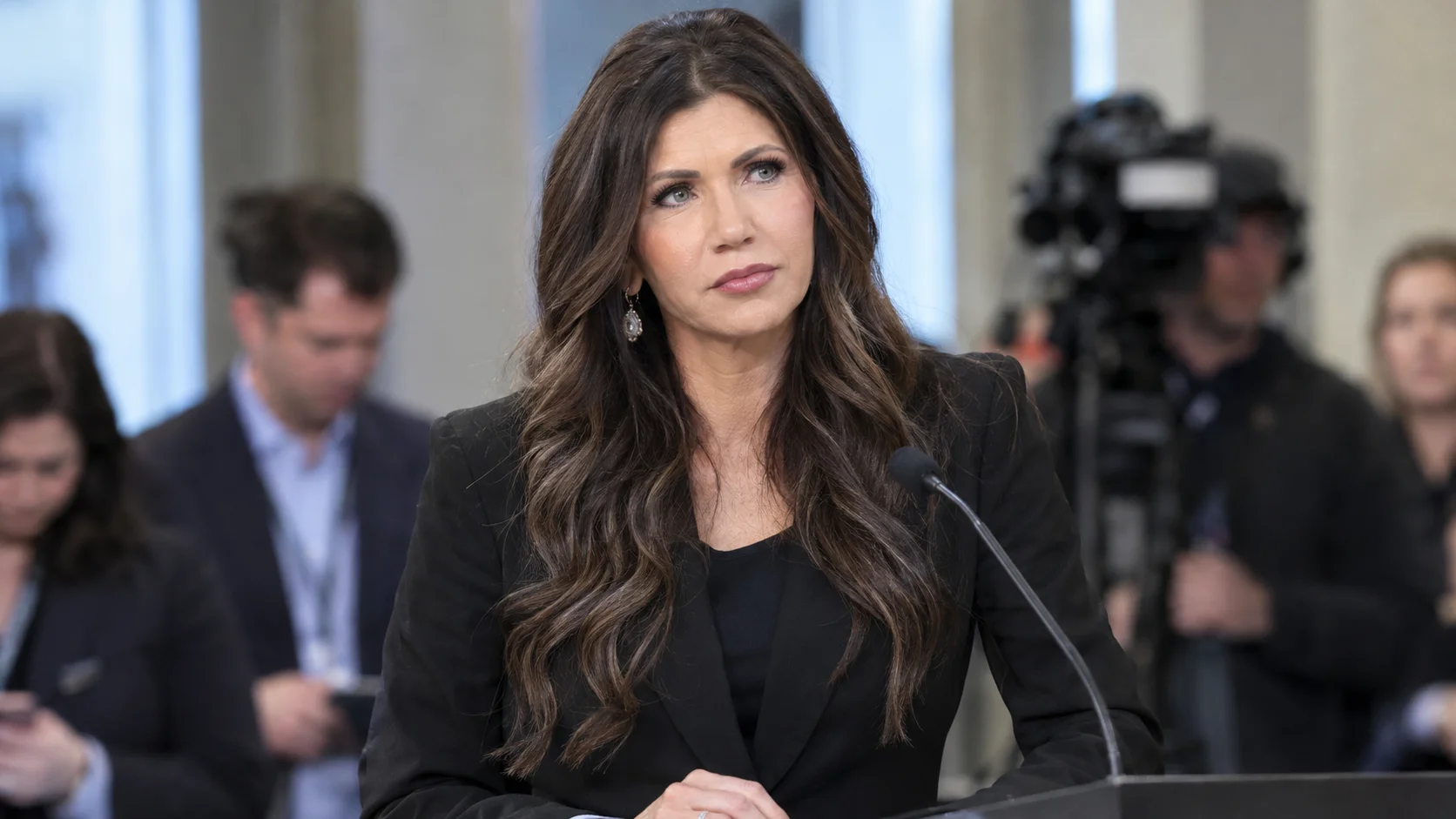
Kristi Noem (born Kristi Lynn Arnold on November 30, 1971) is an American politician, rancher, and executive official who served as the 33rd Governor of South Dakota from 2019 to 2025, the U.S. Representative for South Dakota’s at-large congressional district from 2011 to 2019, and the U.S. Secretary of Homeland Security starting in January 2025. Over two decades in state and federal office, she transitioned from a Hamlin County agricultural legislator into one of the Republican Party’s most prominent executive officials.
Her career tracks a distinct policy trajectory defined by agricultural disaster relief, estate tax reform, pandemic deregulation, and state-level border deployments. While her supporters point to South Dakota’s AAA bond ratings, record low unemployment during the 2020 pandemic, and four-year sales tax reduction as proof of conservative governance, her tenure also generated legal challenges over voter-approved ballot initiatives, state ethics inquiries, formal banishments by all nine of South Dakota’s Native American tribes, and national controversy following the publication of her 2024 memoir.
Kristi Noem Quick Facts and Verified Entity Summary
| Attribute | Verified Record / Official Detail | Primary Source / Filing |
| Full Legal Name | Kristi Lynn Arnold Noem | Biographical Directory of the U.S. Congress (ID: N000184) |
| Date & Place of Birth | November 30, 1971; Watertown, Codington County, South Dakota | South Dakota Legislative Research Council |
| Current / Most Recent Role | U.S. Secretary of Homeland Security (Confirmed January 25, 2025, by a 59–34 Senate vote) | U.S. Senate Roll Call & Department of Homeland Security |
| Previous Executive Office | 33rd Governor of South Dakota (January 5, 2019 – January 25, 2025; succeeded by Larry Rhoden) | South Dakota Office of the Governor |
| Federal Legislative Service | U.S. Representative, South Dakota At-Large (112th–115th Congresses; January 3, 2011 – January 3, 2019) | Office of the Clerk, U.S. House of Representatives |
| State Legislative Service | South Dakota House of Representatives, District 6 (2007–2011; Assistant Majority Leader, 2009–2010) | South Dakota Legislature Historical Archives |
| Education | Northern State University (1990–1994); B.A. in Political Science, South Dakota State University (May 2012) | Congressional Biographical Directory |
| Key Statutory Contributions | 2014 Farm Bill Livestock Indemnity Program (P.L. 113-79); 2017 Tax Cuts and Jobs Act (P.L. 115-97); SD SB 47 (2019) | Congress.gov & South Dakota Codified Laws |
| Published Works | Not My First Rodeo: Lessons from the Heartland (2022); No Going Back (2024) | Twelve Books / Center Street (Hachette Book Group) |
| Spouse & Children | Married Bryon Noem (May 23, 1992); three children (Kassidy, Kennedy, Booker) | Official State Biography |
Federal Transition and Department of Homeland Security Portfolio
Executive ambition defined Noem’s second gubernatorial term. Following the November 2024 presidential election, President-elect Donald Trump nominated Noem to lead the U.S. Department of Homeland Security, placing a former plains-state governor in charge of an agency with more than 260,000 employees and oversight of U.S. Customs and Border Protection (CBP), Immigration and Customs Enforcement (ICE), the Federal Emergency Management Agency (FEMA), the Transportation Security Administration (TSA), and the U.S. Secret Service.
The U.S. Senate confirmed her nomination on January 25, 2025, by a bipartisan vote of 59 to 34. Upon her resignation as governor to accept the federal cabinet post, Lieutenant Governor Larry Rhoden automatically ascended to become the 34th Governor of South Dakota under Article IV, Section 6 of the South Dakota Constitution.
Noem’s selection for the Homeland Security post rested heavily on her aggressive use of state National Guard deployments during her governorship. Between 2021 and 2024, she ordered multiple deployments of South Dakota National Guard personnel to the Texas-Mexico border to assist Texas Governor Greg Abbott’s Operation Lone Star. Her June 2021 deployment drew national legal scrutiny after records revealed it was underwritten by a $1 million private donation from the Tennessee-based Willis and Reba Johnson Foundation, prompting debates among military law specialists over the privatization of state militia operations under Title 32 status versus state active duty.
Early Life, Agricultural Operations, and Entry Into State Politics
Ranching economics shaped Noem’s ideological framework long before she ran for office. Born in Watertown, South Dakota, to Ron and Corinne Arnold, she grew up on the family’s farm and ranch near Castlewood in rural Hamlin County. She enrolled at Northern State University in Aberdeen in 1990 and married Bryon Noem in 1992.
Everything changed on March 31, 1994. Her father, Ron Arnold, died at age 49 in a grain bin machinery accident on the family property. Noem, then 22, left college short of her degree to return home and help manage the family’s Racota Valley Ranch alongside her mother, siblings, and husband.
The financial mechanics of that transition drove her entry into public policy. To keep the cattle and crop operation solvent, the Arnold family had to take out commercial operating loans and structure decade-long payment schedules to settle federal estate tax liabilities assessed under Internal Revenue Code Section 2001. During the late 1990s and early 2000s, Noem diversified the property’s revenue streams by launching a commercial hunting lodge and restaurant whileBryon Noem established an agricultural and commercial insurance agency.
Her work with the South Dakota Farm Bureau and cattlemen’s associations regarding federal tax burdens and agricultural land assessments led local Republican leaders to recruit her for the state legislature. In 2006, she ran for the South Dakota House of Representatives in District 6, which then encompassed Beadle, Clark, Codington, Hamlin, and Kingsbury counties. She won her seat and served two two-year terms from 2007 through 2010, rising to Assistant Majority Leader in 2009.
During her four years in Pierre, she served on the House State Affairs and House Taxation committees, acting as prime sponsor on 41 bills that were signed into law. Her most durable state legislative contribution involved overhauling how South Dakota counties assessed agricultural land for property taxes. Previously, speculative land sales driven by out-of-state recreational buyers inflated local property tax valuations for working farmers. Noem backed statutory reforms shifting South Dakota’s assessment formula from market-price sales comparisons to an agricultural productivity model based on soil classification and eight-year crop and grazing commodity yields.
U.S. House of Representatives Record (2011–2019)
In 2010, Noem challenged three-term Democratic incumbent Stephanie Herseth Sandlin for South Dakota’s sole seat in the U.S. House of Representatives. Running during the Tea Party wave, Noem emerged from a three-way June Republican primary against Secretary of State Chris Nelson and State Representative Blake Curd before facing Herseth Sandlin in the general election.
According to official returns certified by the South Dakota Secretary of State, Noem defeated Herseth Sandlin on November 2, 2010, capturing 153,703 votes (48.14%) to Herseth Sandlin’s 146,589 votes (45.89%), while Independent candidate B. Thomas Marking drew 19,134 votes (5.97%).
Upon arriving in Washington for the 112th Congress in January 2011, House GOP leaders elected her as one of two freshman representatives on the House Republican Steering Committee, which controls committee assignments for the caucus. Simultaneously, she resumed her undergraduate coursework through online and evening credits from Mount Marty College and South Dakota State University, earning her Bachelor of Arts in Political Science from SDSU in May 2012 while serving in Congress.
Her four terms in the U.S. House (verified under her Congress.gov Legislative Profile) centered on three major legislative arenas:
-
The 2014 Farm Bill and the “Atlas” Blizzard Recovery: In early October 2013, Winter Storm Atlas dumped up to four feet of wet snow across western South Dakota before cattle had grown their winter coats, killing more than 43,000 head of livestock. Because the 2008 Farm Bill’s disaster provisions had expired in 2011, ranchers had no federal indemnity coverage. Serving on the House Agriculture Committee and the Conference Committee for the Agricultural Act of 2014 (Public Law 113-79), Noem authored language permanently reauthorizing the Livestock Indemnity Program (LIP) and making payments retroactive to cover the 2013 blizzard losses at 75% of fair market value.
-
Ways and Means Appointment and the 2017 Tax Act: In 2015, Noem became the first South Dakota representative appointed to the House Committee on Ways and Means since E.Y. Berry in the 1950s. During the drafting of the Tax Cuts and Jobs Act of 2017 (Public Law 115-97), she served on the joint House-Senate conference committee. She pushed to double the baseline federal estate and gift tax exemption from $5 million to $10 million per individual (indexed for inflation), directly addressing the estate liquidity problem her family had faced in 1994. She also helped revise Internal Revenue Code Section 199A after an initial statutory glitch threatened to give agricultural cooperatives a massive tax advantage over independent grain buyers.
-
Interstate E-Commerce Sales Tax Collection: Because South Dakota has no personal or corporate state income tax, state budgets rely heavily on retail sales tax receipts. In Congress, Noem introduced federal remote-seller legislation and supported South Dakota’s legal strategy to challenge the 1992 physical-presence rule established in Quill Corp. v. North Dakota. That effort culminated in the U.S. Supreme Court’s 5–4 decision in South Dakota v. Wayfair, Inc. (585 U.S. 162, 2018), which permitted states to mandate sales tax collection from out-of-state online merchants exceeding specific economic nexus thresholds (200 transactions or $100,000 in annual in-state sales).
Governorship of South Dakota: Fiscal, Regulatory, and Pandemic Policies
Rather than seeking a fifth term in the U.S. House, Noem announced on November 14, 2016, that she would run for Governor of South Dakota in 2018. She first defeated three-term South Dakota Attorney General Marty Jackley in the June 5, 2018, Republican primary by a margin of 56.0% to 44.0%.
The November 2018 general election proved far tighter than normal for a state that had not elected a Democratic governor since Harvey Wollman left office in 1979. Facing Democratic State Senate Minority Leader Billie Sutton, a former rodeo bronc rider paralyzed in a 2007 saddle-bronc accident, Noem won by just 11,458 votes: 172,912 (50.97%) to Sutton’s 161,454 (47.60%). Sworn in on January 5, 2019, she became South Dakota’s first female governor.
Second Amendment and Occupational Licensing Legislation
Eleven days after taking the oath of office, Noem advanced her first major legislative priority. On January 31, 2019, she signed Senate Bill 47 (SB 47), making South Dakota the 14th state to enact “constitutional carry” by repealing the statutory requirement to hold a permit to carry a concealed handgun for any resident legally allowed to possess a firearm.
In 2021, following economic migration shifts, she signed House Bill 1077, which expanded universal occupational licensing reciprocity across healthcare, construction, and technical trades for workers relocating to South Dakota with valid out-of-state credentials.
The 2020 Pandemic Deregulation Strategy and Trade-Offs
Noem’s national profile rose sharply in the spring of 2020 during the COVID-19 pandemic. While 43 U.S. governors issued mandatory statewide stay-at-home orders, Noem refused to order statewide business closures, shelter-in-place mandates, or statewide mask requirements. She argued that South Dakota’s executive emergency powers under SDCL Chapter 34-48A did not authorize the governor to halt private commerce or restrict religious gatherings.
The empirical results of this non-interventionist approach created a stark split between economic performance and public health metrics:
-
Labor and Fiscal Metrics: According to the South Dakota Bureau of Finance and Management and the U.S. Bureau of Labor Statistics, South Dakota’s seasonally adjusted unemployment rate peaked at 9.2% in April 2020—well below the 14.8% national peak—and fell back to 3.0% by December 2020. Supported by $1.25 billion in federal CARES Act Coronavirus Relief Fund allocations and rebounding tourism receipts, the state ended Fiscal Year 2021 with an unappropriated general fund surplus exceeding $86 million while maintaining AAA credit ratings across S&P Global, Moody’s, and Fitch.
-
Public Health Surge: After the state hosted the 80th Sturgis Motorcycle Rally in August 2020 (which drew roughly 460,000 attendees and vehicles to Meade County), South Dakota experienced one of the highest per-capita COVID-19 infection and hospitalization spikes in the United States between October and November 2020. By late 2021, cumulative mortality data from the South Dakota Department of Health recorded more than 2,400 COVID-19 deaths in a state of approximately 895,000 residents.
2022 Re-Election and the 2023 Tax Cut Compromise
Voters rewarded her pandemic economic posture in November 2022. Running against Democratic House Minority Leader Jamie Smith, Noem won re-election by nearly 27 percentage points, securing 217,035 votes (61.98%) to Smith’s 123,148 votes (35.17%)—the largest raw vote total ever recorded by a gubernatorial candidate in South Dakota history.
During the 2022 campaign, Noem pledged to permanently repeal South Dakota’s 4.5% state sales tax on groceries, an initiative estimated to reduce state revenue by more than $100 million annually. However, during the 2023 legislative session, Republican supermajorities in the State Senate Appropriations Committee blocked the permanent food tax repeal, citing concerns that narrowing the tax base would force future cuts to K-12 education and Medicaid funding during an agricultural downturn. Noem signed a compromise measure, House Bill 1137, which temporarily reduced the overall state general sales and use tax rate across all goods from 4.5% to 4.2% between July 1, 2023, and June 30, 2027.
Constitutional Clashes, Ethics Scrutiny, and Public Controversies
An objective assessment of Noem’s executive record requires examining four major legal, ethical, and political controversies that defined her later years in Pierre.
1. Nullification of Voter-Approved Constitutional Amendment A (2020–2021)
In November 2020, South Dakota voters approved Constitutional Amendment A by a margin of 54.18% to 45.82% (225,260 votes to 190,477), making South Dakota the first state to simultaneously approve both medical (Initiated Measure 26) and recreational cannabis in the same election cycle.
Noem opposed legalization and issued Executive Order 2021-02 directing Highway Patrol Superintendent Colonel Rick Miller to file a constitutional lawsuit challenging the voter-approved amendment. In Thom v. Barnett (2021 SD 65), decided on November 24, 2021, the South Dakota Supreme Court ruled 4–1 in favor of the administration’s challenge. The court held that Amendment A violated the single-subject requirement of Article XXIII, Section 1 of the South Dakota Constitution and constituted an unratified constitutional revision rather than a simple amendment, striking down the recreational legalization measure despite its electoral majority.
2. State Appraiser Certification Program Inquiry (2021–2022)
In September 2021, the Associated Press reported that Noem had hosted a private meeting at the Governor’s Mansion on July 27, 2020, shortly after the state’s Appraiser Certification Program notified her daughter, Kassidy Peters, that her application to become a state-certified residential real estate appraiser was headed for denial due to deficient work samples. Attendees at the mansion meeting included Peters, Labor Secretary Marcia Hultman, state legal counsel, and longtime Appraiser Certification Program executive director Sherry Bren.
Four months after that meeting, Peters received her certification, and Bren, then 70, was pressured to retire, eventually receiving a $200,000 state settlement to withdraw an age-discrimination complaint. The Legislature’s Government Operations and Audit Committee (GOAC) subpoenaed Bren, and the South Dakota Government Accountability Board opened a formal review into complaints filed by former Attorney General Jason Ravnsborg. In August 2022, the Accountability Board dismissed the complaints without finding statutory malfeasance, while Peters voluntarily allowed her appraisal license to expire at the end of 2021 after disclosing she was wrapping up her appraisal business.
3. Reservation Banishments by South Dakota’s Nine Sioux Tribes (2024)
During a January 31, 2024, joint address to the South Dakota Legislature requesting authorization to deploy additional National Guard troops to the southern border, Noem alleged that Mexican drug cartels were operating on South Dakota’s Native American reservations and succeeding because tribal leaders were personally benefitting from cartel presence. Later in March 2024, at town hall events in Mitchell and Winners, she made additional remarks criticizing tribal officials and parenting on reservations.
The statements triggered an unprecedented diplomatic breakdown between the Governor’s Office in Pierre and tribal governments. Between February 2, 2024, and May 21, 2024, all nine federally recognized sovereign tribes within South Dakota’s borders—the Oglala Sioux Tribe, Cheyenne River Sioux Tribe, Standing Rock Sioux Tribe, Rosebud Sioux Tribe, Crow Creek Sioux Tribe, Yankton Sioux Tribe, Sisseton Wahpeton Oyate, Flandreau Santee Sioux Tribe, and Lower Brule Sioux Tribe—passed formal tribal council resolutions banishing Noem from entering their respective reservation territories, which collectively span roughly 12% of South Dakota’s land mass.
4. The No Going Back Memoir Disclosures (May 2024)
On May 7, 2024, Hachette Book Group imprint Center Street published Noem’s second book, No Going Back: The Truth on What’s Wrong with Politics and How We Move America Forward, positioned ahead of the 2024 Republican vice-presidential selection process. Pre-publication review copies revealed two passages that dominated national political coverage:
-
The Gravel Pit Account: Noem wrote that she had personally shot and killed her family’s 14-month-old wirehaired pointer, Cricket, in a farm gravel pit after the dog proved “untrainable” for pheasant hunting and killed a local family’s chickens, followed immediately by shooting an aggressive family goat. Noem included the story to illustrate her willingness to execute unpleasant duties in life and governance, though animal welfare groups and political strategists from both parties criticized the account.
-
Retracted North Korea Claim: In the initial print run, Noem wrote that while serving on the House Armed Services Committee, she had traveled to Asia and met with North Korean dictator Kim Jong Un, describing him as underestimating her and comparing him to “little tyrants” she had met as a children’s pastor. Congressional travel logs and Armed Services Committee records immediately showed she had never visited North Korea or met Kim Jong Un. Her publisher, Center Street, subsequently excised the passage from the audiobook and future print editions at Noem’s request.
Complete Chronological Career and Electoral Timeline
| Year / Date | Milestone or Official Action | Verified Outcome / Statutory Metric |
| March 31, 1994 | Death of father Ron Arnold in farm accident | Leaves Northern State University at age 22 to co-manage Racota Valley Ranch in Hamlin County. |
| November 7, 2006 | Elected to SD House of Representatives (District 6) | Begins first of two terms in Pierre (2007–2011); named Assistant Majority Leader in 2009. |
| November 2, 2010 | Elected to U.S. House of Representatives (SD At-Large) | Defeats Democratic incumbent Stephanie Herseth Sandlin (48.14% to 45.89%; 153,703 to 146,589 votes). |
| May 2012 | Completes undergraduate degree while in office | Graduates from South Dakota State University with a B.A. in Political Science. |
| November 6, 2012 | Re-elected to 113th U.S. Congress | Defeats Democrat Matt Varilek (57.45% to 42.55%; 207,640 to 153,789 votes). |
| February 7, 2014 | Enactment of Agricultural Act of 2014 (P.L. 113-79) | Secures retroactive Livestock Indemnity Program (LIP) funding following the 2013 Atlas blizzard. |
| November 4, 2014 | Re-elected to 114th U.S. Congress | Defeats Democrat Corinna Robinson (66.53% to 33.47%; 183,834 to 92,485 votes); joins Ways and Means Committee in 2015. |
| November 8, 2016 | Re-elected to 115th U.S. Congress | Defeats Democrat Paula Hawks (64.10% to 35.90%; 237,163 to 132,810 votes). |
| December 22, 2017 | Enactment of Tax Cuts and Jobs Act (P.L. 115-97) | Conference committee member; doubles federal estate tax exemption threshold. |
| November 6, 2018 | Elected 33rd Governor of South Dakota | Defeats Democrat Billie Sutton (50.97% to 47.60%; 172,912 to 161,454 votes); first female governor of SD. |
| January 31, 2019 | Signs Senate Bill 47 (Constitutional Carry) | Eliminates concealed pistol permit requirements in South Dakota effective July 1, 2019. |
| November 24, 2021 | Thom v. Barnett (2021 SD 65) Decision | SD Supreme Court upholds Noem administration’s challenge, nullifying voter-approved Amendment A. |
| November 8, 2022 | Re-elected Governor of South Dakota | Defeats Democrat Jamie Smith (61.98% to 35.17%; record 217,035 total votes). |
| March 2023 | Signs House Bill 1137 (Sales Tax Reduction) | Reduces state general sales tax rate from 4.5% to 4.2% for a four-year sunset period (2023–2027). |
| May 2024 | Publication of No Going Back & Tribal Bans | All 9 SD Sioux tribes vote to banish Noem from reservation lands; memoir triggers national controversy. |
| January 25, 2025 | Confirmed as U.S. Secretary of Homeland Security | Confirmed by U.S. Senate (59–34 vote); resigns governorship, succeeded by Lt. Gov. Larry Rhoden. |
Frequently Asked Questions
What offices has Kristi Noem held in state and federal government?
Kristi Noem has held three primary elected and appointed public offices: State Representative for South Dakota’s 6th Legislative District (2007–2011), U.S. Representative for South Dakota’s at-large congressional district (2011–2019), 33rd Governor of South Dakota (2019–2025), and U.S. Secretary of Homeland Security (confirmed in January 2025).
Who succeeded Kristi Noem as Governor of South Dakota?
Lieutenant Governor Larry Rhoden, a lifelong rancher and former leader in the South Dakota House and Senate from Union Center, succeeded Noem as the 34th Governor of South Dakota in January 2025 following her Senate confirmation as Secretary of Homeland Security, in accordance with Article IV, Section 6 of the South Dakota Constitution.
Why did South Dakota’s Native American tribes ban Kristi Noem in 2024?
Between February and May 2024, all nine federally recognized Sioux tribes in South Dakota voted to banish Noem from their reservation lands after she stated during a legislative address and subsequent town halls that Mexican drug cartels were operating on tribal lands and alleged that tribal leaders were personally benefitting from cartel activity.
Where did Kristi Noem attend college and earn her degree?
Noem attended Northern State University in Aberdeen, South Dakota, from 1990 to 1994 before leaving early after her father died in a farm accident. She later completed night and online coursework through Mount Marty College’s Watertown campus and South Dakota State University, graduating from SDSU with a Bachelor of Arts in Political Science in May 2012 while serving in the U.S. House of Representatives.
What was Kristi Noem’s voting record and committee role in Congress?
During her eight years in the U.S. House (2011–2019), Noem served on the House Agriculture Committee, the House Natural Resources Committee, the House Armed Services Committee, and the House Ways and Means Committee. According to congressional roll-call archives at Bioguide.Congress.gov, she helped write the livestock indemnity provisions of the 2014 Farm Bill and served on the conference committee that finalized the 2017 Tax Cuts and Jobs Act.
What do you feel about this post?

Like

Love

Happy

Haha

Sad

Angry

I am an independent writer and digital researcher tracking everyday trends, tech shifts, and modern culture across the US. I focus on cutting through internet noise to bring you crisp, honest stories and practical takeaways you can actually use.