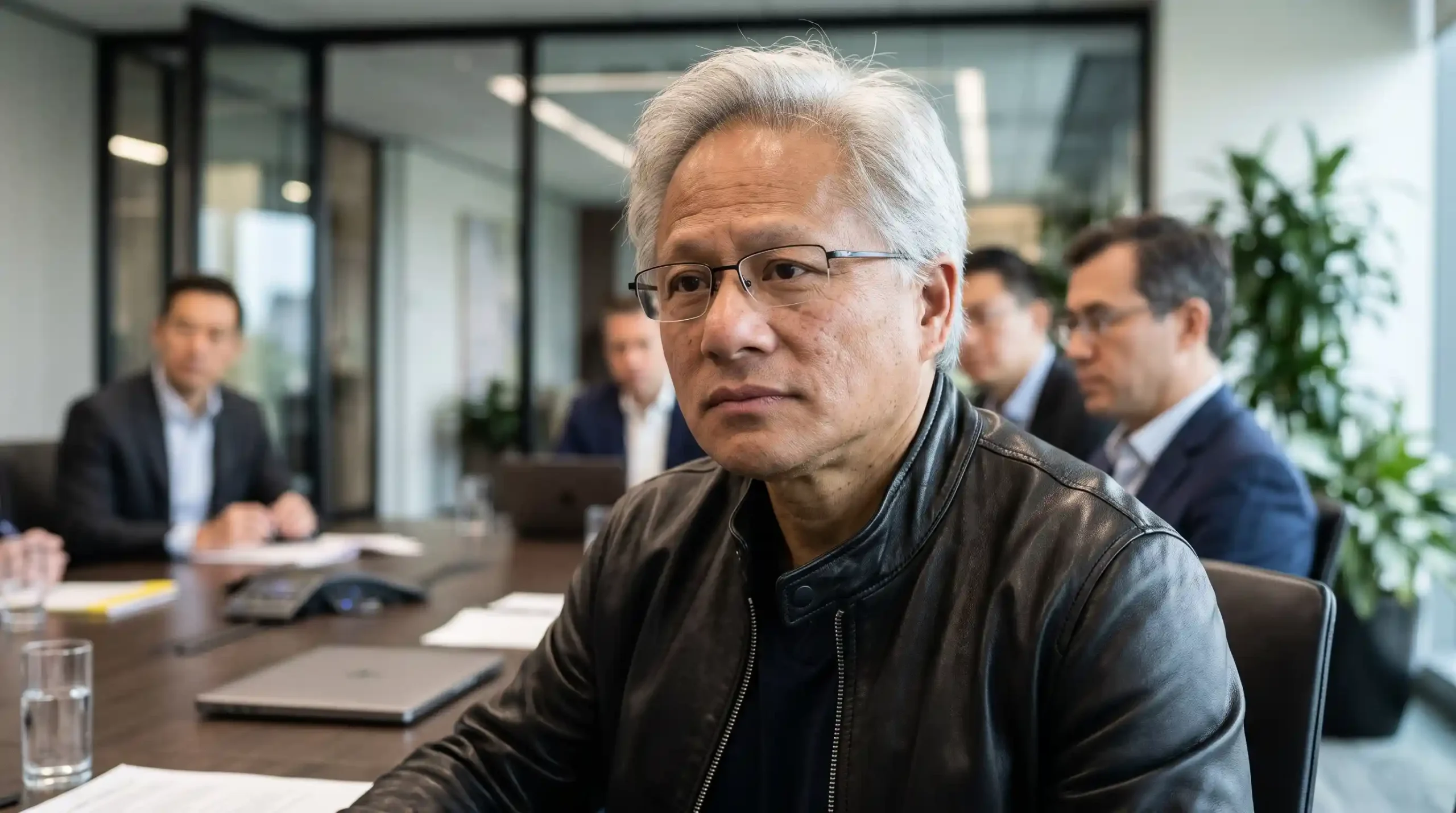
Jensen Huang’s Third Reported Affair Caps a Stunning Fall at Nvidia
Just hours after Jensen Huang stepped down from his 33 year run as the chief executive of Nvidia on Thursday, November 12, 2026, a new report from Reuters revealed that the billionaire cofounder had a third extramarital affair. According to two sources familiar with the internal matter, this third relationship involved a second Nvidia employee whose name has been withheld to protect her privacy.
The news arrived as Wall Street was already reeling from Nvidia’s announcement that Huang had vacated his roles as president, chief executive, and board member. What started two weeks ago as a national security inquiry into a foreign businesswoman quickly snowballed into an internal workplace governance crisis that cost the tech industry’s biggest star his job and wiped roughly 888 billion dollars from Nvidia’s market value in a single week.
How the Third Affair Changed the Narrative
When news first broke in late October and early November about Huang’s relationship with Alice Huang, a former executive at the Singapore cloud firm Megaspeed whom US intelligence officials suspected of having ties to Beijing, Silicon Valley initially rallied around him. On November 8, Jensen Huang sent a candid note to employees admitting he had been unfaithful to his wife, Lori Huang, while maintaining he had no idea Alice Huang was suspected of espionage. At that stage, the board of directors publicly backed him and hired the law firm Wachtell, Lipton, Rosen and Katz, alongside former acting US attorney Joon H. Kim, to run an independent review.
Even President Donald Trump weighed in during a November 9 press conference, telling reporters he spoke directly with Huang and believed the executive had no clue about any foreign intelligence ties. On Tuesday, November 12, officials in the Justice Department and the intelligence community also signaled to outlets like CNN and Reuters that there was still no hard proof Alice Huang was a spy, calling some of the early intelligence characterizations overstated.
If the scandal had stopped with an outside business acquaintance, Huang likely would have kept his leather jacket and his corner office. What actually ended his tenure was what investigators and reporters uncovered inside Nvidia’s own Santa Clara headquarters.
On Wednesday, November 11, The New York Times reported a second affair, this time with Kimberly Powell, Nvidia’s 48 year old vice president of healthcare, who had worked at the company for nearly two decades and reported directly to Huang. Then, on Thursday afternoon following his resignation, Mediaite and Reuters confirmed that Huang had also been romantically involved with another woman on the Nvidia payroll. Neither Nvidia, Huang, nor Powell responded to media requests for comment regarding the third relationship.
Why Workplace Relationships Forced the Board’s Hand
For years, business schools and tech blogs praised Jensen Huang’s unusual management style. Unlike most chief executives who manage five or six top deputies, Huang oversaw roughly 60 direct reports. He famously bragged in interviews that he never held one on one meetings, preferring group discussions and open emails so everyone shared the same information.
Across Silicon Valley forums and local Bay Area community threads, tech workers were quick to point out the irony of that claim once two internal relationships came to light. More importantly, in the eyes of corporate law, an affair with someone outside the company is a personal matter, whereas multiple undisclosed relationships with subordinates inside the building represent a textbook conflict of interest.
Nvidia’s internal code of conduct explicitly forbids undisclosed conflicts of interest across reporting lines. Once a chief executive is romantically linked to direct reports or internal staff, the company becomes exposed to massive legal liability regarding promotions, stock grants, pay equity, and potential harassment claims. A California retail investor, Mark Kistenmacher, had already filed a shareholder lawsuit on November 10 accusing the company of failing to disclose risks tied to the CEO’s personal conduct.
There is also a structural reason Huang could not simply overrule his board the way some tech founders do. While Huang owns more than 870 million shares of Nvidia, that stake represents about 3.58 percent of the company’s voting power, without any special super-voting stock class. When the board convened on November 11 to review the internal findings, Huang did not have the voting shares to block an ouster. According to Securities and Exchange Commission filings, the board formally accepted his immediate resignation that Wednesday evening before announcing it to the public on Thursday morning.
Timeline of the 15-Day Collapse
The speed of the leadership crisis caught even veteran semiconductor analysts off guard. Key events unfolded over a rapid two-week span:
-
On October 29, initial reports surfaced in The New York Times that federal intelligence agencies were investigating whether a woman close to Jensen Huang was part of a Chinese intelligence operation targeting the chipmaker.
-
Between November 6 and November 7, follow-up stories in the Financial Times and The New York Times identified the woman as Alice Huang of Singapore’s Megaspeed and reported the pair had been photographed together in Taiwan, Singapore, and California.
-
On November 8, Jensen Huang issued an internal apology admitting to an extramarital affair and asking for privacy for his wife and children. Nvidia’s board announced an outside investigation by Wachtell Lipton while stating it still had full confidence in Huang.
-
On November 10, shareholder litigation hit federal court in California as Lawmakers in Washington began demanding briefings on Megaspeed’s access to high-end AI chips.
-
On November 11, reports broke detailing a second affair with direct report and Vice President of Healthcare Kimberly Powell. The Nvidia board held an emergency session stretching into the night and accepted Huang’s resignation.
-
On November 12, Nvidia officially announced Huang’s departure, naming longtime Chief Financial Officer Colette Kress as interim CEO and board veteran Harvey C. Jones as the company’s first-ever Chair of the Board. Hours later, Reuters broke the story of the third affair involving a second Nvidia employee.
The Personal and Financial Stakes for the Huang Family
Beyond the executive suite, the revelations have created a deeply complicated family situation inside the company itself. Jensen Huang met his wife, Lori Mills, when they were undergraduate electrical engineering lab partners at Oregon State University in the early 1980s. Together for over four decades, the couple built the Jen-Hsun and Lori Huang Foundation into one of the largest philanthropic funds in the United States. Both of their adult children, Madison Huang and Spencer Huang, also work at Nvidia.
As Mashable noted in its analysis of the couple’s holdings, Jensen and Lori Huang are deeply intertwined in Nvidia’s ownership structure. Public SEC filings from September show the couple serve as co-trustees across three trusts holding roughly 608 million Nvidia shares directly, alongside additional shares held through family living trusts. While Lori Huang has made no public comment and no divorce filing has been announced, legal experts note that California’s community property laws and their shared voting power over those trusts make their personal relationship a major focus for institutional shareholders watching for any potential stock sales.
What Happens Next for Nvidia Investors and Congress
Nvidia now faces the toughest test in its corporate history just days before its scheduled third-quarter fiscal 2027 earnings release on November 17. Shares of the chipmaker fell as low as 148.80 dollars during Thursday’s chaotic trading session before closing near 164 dollars, putting the stock down more than 30 percent from its October highs.
To calm institutional investors, the board turned to Colette Kress, who has served as Nvidia’s chief financial officer since 2013 after holding senior finance roles at Microsoft and Cisco. Kress is widely respected on Wall Street and knows the supply chain numbers backward and forward. Alongside Harvey C. Jones stepping in as board chair, the company made it clear it is evaluating both internal executives and outside industry leaders for the permanent CEO seat.
For Jensen Huang, stepping away from Nvidia does not mean stepping out of the public eye. According to The Guardian’s coverage, House Foreign Affairs Committee Chairman Brian Mast confirmed on Thursday that Huang has agreed to testify voluntarily before the US Congress after lawmakers threatened him with a formal subpoena. Even though the internal affairs with Nvidia employees were what ultimately cost him his job, Washington lawmakers still want answers under oath about his interactions with Megaspeed and how Nvidia polices access to its most sensitive artificial intelligence hardware.
What do you feel about this post?

Like

Love

Happy

Haha

Sad

Angry

I am an independent writer and digital researcher tracking everyday trends, tech shifts, and modern culture across the US. I focus on cutting through internet noise to bring you crisp, honest stories and practical takeaways you can actually use.