Jason Galanis: From $80 Million Wall Street and Tribal Bond Frauds to Federal Clemency and Public Reinvention
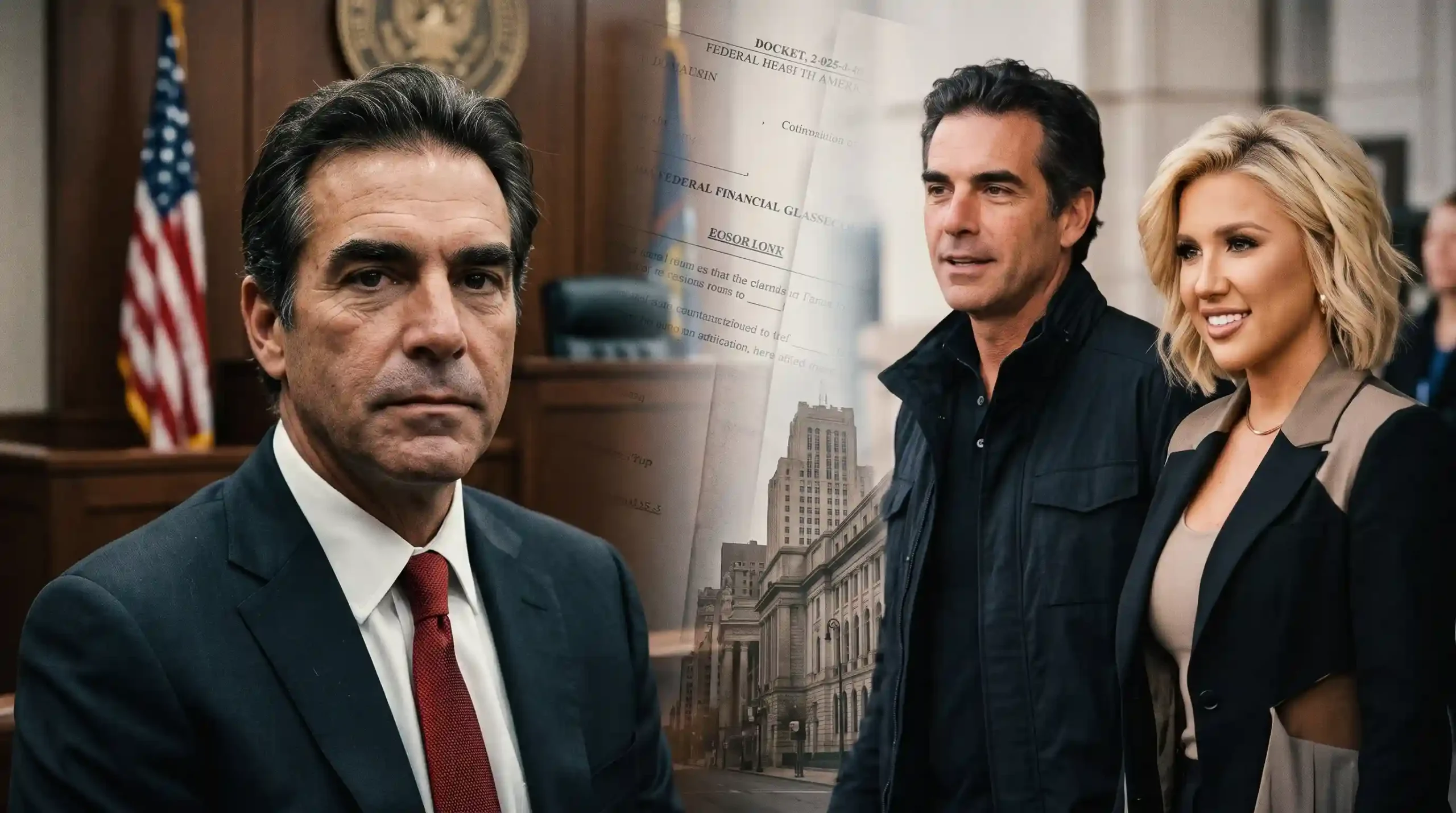
Jason Galanis, a 56-year-old former financier once dubbed “Baby Face” on Wall Street, spent nearly a decade in federal custody for orchestrating two overlapping securities fraud schemes totaling more than $80 million in investor and tribal losses before President Donald Trump commuted his 15-year sentence on March 28, 2025. In late October 2026, Galanis re-entered the national spotlight after reality television personality Savannah Chrisley confirmed that he is her fiancé and the father of her expecting child, having met through her father, Todd Chrisley, while both men were incarcerated at Federal Correctional Institution (FCI) Pensacola and FCI Montgomery.
Understanding Galanis’s trajectory requires looking past tabloid headlines into two decades of Securities and Exchange Commission (SEC) enforcement actions, Southern District of New York (SDNY) criminal dockets, and congressional impeachment transcripts. Across multiple market cycles, Galanis operated through a consistent financial blueprint: acquiring captive investment advisory firms, installing compliant officers to bypass regulatory bars, and using discretionary client accounts as liquidity sinks for illiquid securities he secretly controlled.
The Generational Playbook: From Penthouse Accounting to SEC Bars
Long before the tribal bond indictments of 2015 and 2016, the Galanis surname carried a distinct history in federal securities enforcement. Jason Galanis’s father, John P. (“Yanni”) Galanis, was first pursued by the SEC in 1971 for manipulating over-the-counter securities and later convicted in the late 1980s for masterminding sprawling tax-shelter, penny-stock, and savings-and-loan frauds.
Jason Galanis initially built his career in the late 1990s dot-com boom through incubation and credit-card processing ventures before intersecting with distressed media assets. In January 2005, the SEC filed a civil enforcement action, SEC v. Penthouse International, Inc., Charles Samel and Jason Galanis, in the Southern District of New York. Regulators alleged that Galanis, then a major Penthouse shareholder, and former officer Charles Samel prepared and filed a materially false Form 10-Q for the quarter ended March 31, 2003.
The accounting mechanics in the Penthouse case established the regulatory constraints that shaped Galanis’s subsequent career:
-
Penthouse improperly booked a $1 million upfront payment from a five-year website management agreement as immediate quarterly revenue rather than amortizing it as deferred revenue under Generally Accepted Accounting Principles (GAAP), even though the contract was not signed until the following quarter.
-
That single accounting entry inflated quarterly revenue by roughly 9% (from $11,072,000 to $12,072,000) and flipped a net loss of $167,000 into a reported net profit of $828,000.
-
The filing carried the unauthorized electronic signature and Sarbanes-Oxley certification of Penthouse founder Robert C. Guccione, who had neither reviewed nor approved the document.
To settle the SEC charges in May 2007 without admitting or denying the allegations, Galanis consented to a five-year SEC officer-and-director bar and paid a $60,000 civil penalty. Because federal law prohibited him from serving as a named executive or board member of any publicly traded issuer during that window, his subsequent operations relied on nominee shareholders, offshore shells, and proxy executives.
Anatomy of the Two Major Federal Fraud Convictions
Between 2007 and 2016, federal prosecutors in Manhattan charged Galanis across two separate criminal dockets involving three distinct financial schemes. Rather than relying on simple retail Ponzi structures, these operations exploited institutional settlement plumbing, transfer-agent legend removals, and fiduciary breaches at registered investment advisers (RIAs).
| Case / Scheme | Active Period | Primary Vehicles & Entities Involved | Core Mechanical Violation | Verified Financial Impact & Sentence |
| Gerova Financial & TAG Virgin Islands | 2007–2011 | Gerova Financial Group Ltd., TAG Virgin Islands (TAG VI), Martin Kelly Capital | Evaded SEC officer bar; issued 5.33M unrestricted shares to foreign nominee Ymer Shahini; bribed RIAs to buy dumped shares in client accounts. | ~$20M illicit profit; initially sentenced to 135 months; resentenced in Sept 2020 to 189 months total (concurrent/combined structure). |
| Wakpamni Lake Tribal Bonds | 2014–2016 | Wakpamni Lake Community Corp. (WLCC), Hughes Capital Management, Atlantic Asset Management | Induced Oglala Sioux tribal entity to issue $60M+ in illiquid bonds; forced captive pension/advisory accounts to buy them; looted proceeds. | $38M+ diverted via WAPCC; $8.5M spent personally by Galanis; sentenced Aug 2017 to 173 months; $43M+ tribal restitution ordered. |
1. The Gerova Financial Pump-and-Dump and Advisory Capture (2007–2011)
While barred from holding public company office, Galanis quietly seized operational control of Gerova Financial Group, Ltd., a Cayman Islands-registered special purpose acquisition company (SPAC) that purported to operate as an international reinsurance firm listed on the New York Stock Exchange. According to the SEC’s 2015 civil complaint and the Department of Justice’s January 2020 guilty plea announcement, Galanis worked alongside his father John Galanis, brothers Jared and Derek Galanis, and Gerova president Gary Hirst.
On May 26, 2010, at Jason Galanis’s direction, Hirst instructed Gerova’s transfer agent to issue 5,333,333 ordinary shares, representing nearly half of the company’s public float, without restrictive legends to Ymer Shahini, a Kosovo citizen acting as a foreign nominee. Because dumping five million shares on the open market would crash the stock price, Galanis engineered artificial buy-side demand. He paid secret kickbacks to corrupt investment advisers, including Gavin Hamels, Bill Crafton Jr., and James Tagliaferri of St. Thomas-based TAG Virgin Islands, who used discretionary authority to buy Gerova shares inside unsuspecting retail and institutional client accounts at matched times and prices. The scheme generated nearly $20 million in illicit proceeds before NYSE halted trading in Gerova in early 2011.
2. The Wakpamni Lake Community Tribal Bond Scheme (2014–2016)
Even as regulators investigated the Gerova collapse, Galanis launched a second, larger fraud targeting both a Native American community and institutional pension funds. According to the U.S. Attorney’s Office for the Southern District of New York, between March 2014 and April 2016, Galanis and his co-defendants, including his father John Galanis, Hugh Dunkerley, Gary Hirst, Michelle Morton, Bevan Cooney, and Devon Archer, convinced the Wakpamni Lake Community Corporation (WLCC), an economic development arm of the Oglala Sioux Tribe in Pine Ridge, South Dakota, to issue more than $60 million in limited-recourse tribal economic development bonds.
Under the closing documents, bond proceeds were supposed to be placed with an independent investment manager to purchase annuity contracts that would cover bond interest and fund vital tribal infrastructure. Instead, zero dollars reached the designated annuity manager. Galanis routed the proceeds into a Florida shell account named Wealth Assurance Private Client Corporation (WAPCC), diverting more than $38 million into accounts under his control. Prosecutors proved that Galanis recycled roughly $15 million of the stolen bond money to buy back later tranches of the exact same bonds, creating the illusion of institutional demand, while spending over $8.5 million on personal real estate in Bel Air and Manhattan, luxury travel, and jewelry.
To offload the unrated, completely illiquid bonds, Galanis’s group acquired control of two registered investment advisers: Hughes Capital Management and Atlantic Asset Management. Without notifying clients or disclosing glaring conflicts of interest, the conspirators dumped the Wakpamni bonds into captive accounts belonging to municipal transit workers, housing authorities, and union pension funds. When those pension funds demanded liquidation, the bonds had no secondary market and defaulted entirely.
Federal Sentencing and Restitution Discrepancies
Federal sentencing records across the two cases frequently cause confusion in secondary media reporting because Galanis was sentenced in multiple phases:
-
In February 2017, Galanis was sentenced to 135 months in prison for the Gerova Financial fraud and ordered to forfeit $37,032,337.43.
-
In August 2017, U.S. District Judge Ronnie Abrams sentenced him to an additional 173 months in the Wakpamni tribal bond case (with 60 months running concurrently and 113 months consecutively).
-
Following an appellate remand regarding how the two sentences interacted, Judge P. Kevin Castel resentenced Galanis on September 24, 2020 to an aggregate term of 189 months (15 years and 9 months) in prison, alongside forfeiture and restitution obligations exceeding $80 million across the combined dockets.
The Burnham Group, Hunter Biden, and the 2024 Congressional Deposition
While executing the tribal bond transactions between 2012 and 2015, Galanis partnered with Devon Archer and Hunter Biden to assemble a private equity and wealth-management roll-up anchored by the Burnham Financial Group (a surviving brand remnant of Drexel Burnham Lambert). Neither Hunter Biden nor Joe Biden was ever charged in connection with the Wakpamni tribal bond fraud (Devon Archer was convicted alongside Galanis in 2018 and later pardoned by President Trump on March 25, 2025).
On February 23, 2024, House investigators traveled to FCI Montgomery in Alabama to conduct a transcribed interview with Galanis as part of the Republican-led impeachment inquiry into then-President Joe Biden. In his official House Oversight Committee deposition transcript, Galanis testified that his consortium sought to combine a legacy Wall Street name with a globally recognized political brand to attract sovereign wealth and institutional capital from China, Kazakhstan, and Russia, including discussions with Henry Zhao of Harvest Fund Management and Russian billionaire Yelena Baturina.
During that sworn interview, Galanis stated that Hunter Biden’s primary contribution to the Burnham venture was “relationship capital” and access to his father, recounting two occasions, including a May 2014 gathering at the Peninsula Hotel bar in Manhattan and an earlier speakerphone call involving Baturina, where Hunter Biden telephoned Vice President Joe Biden to exchange pleasantries in front of business associates. However, under cross-examination by Democratic committee counsel within the same transcript, Galanis acknowledged two critical boundary facts:
-
He never witnessed Joe Biden take any official policy action to benefit Burnham or its foreign partners.
-
While incarcerated during the 2020 election cycle, Galanis had actively sought clemency from the first Trump administration via associates Rudy Giuliani and Tony Bobulinski, and alleged in his testimony that SDN Y prosecutors delayed his Rule 35 sentence-reduction cooperation efforts for political reasons, a claim federal prosecutors and Democratic lawmakers rejected as an effort by a convicted fraudster to curry favor for a future presidential commutation.
The March 2025 Presidential Commutation and 2026 Developments
Thirteen months after his congressional testimony, Galanis received the executive relief he had pursued for years. According to the Department of Justice Office of the Pardon Attorney ledger, on March 28, 2025, President Donald Trump granted an executive commutation of Galanis’s prison sentence across both Southern District of New York dockets, authorizing his immediate release from federal custody while leaving his underlying felony convictions on the record. The grant later became one of several high-profile financial clemency actions examined when Senate and House Democrats launched a bicameral congressional investigation into white-collar pardons and commutations in May 2026.
Following his release in spring 2025, Galanis transitioned back into private life before making headlines in late October 2026. On October 27, 2026, reality television personality and podcaster Savannah Chrisley (29), whose parents, Todd and Julie Chrisley, were pardoned by President Trump in May 2025 following their own federal bank fraud and tax evasion convictions, announced on Instagram and her Unlocked podcast that she was engaged and expecting her first child.
Within hours, multiple outlets including Us Weekly and Extra TV confirmed that her 56-year-old fiancé is Jason Galanis. Key verified details of their connection include:
-
Galanis and Todd Chrisley served overlapping time together inside the federal prison system prior to their respective 2025 clemency grants.
-
Savannah Chrisley and Galanis began dating in July 2025, four months after his sentence was commuted, and became engaged during a trip to the Cayman Islands in December 2025.
-
Originally scheduled to marry in January 2027, the couple pushed their wedding date to May 2027 following the pregnancy announcement, with Chrisley publicly defending their 27-year age gap and stating that their unborn child should not be judged by the controversy surrounding Galanis’s past federal convictions.
What do you feel about this post?

Like

Love

Happy

Haha

Sad

Angry

I am an independent writer and digital researcher tracking everyday trends, tech shifts, and modern culture across the US. I focus on cutting through internet noise to bring you crisp, honest stories and practical takeaways you can actually use.