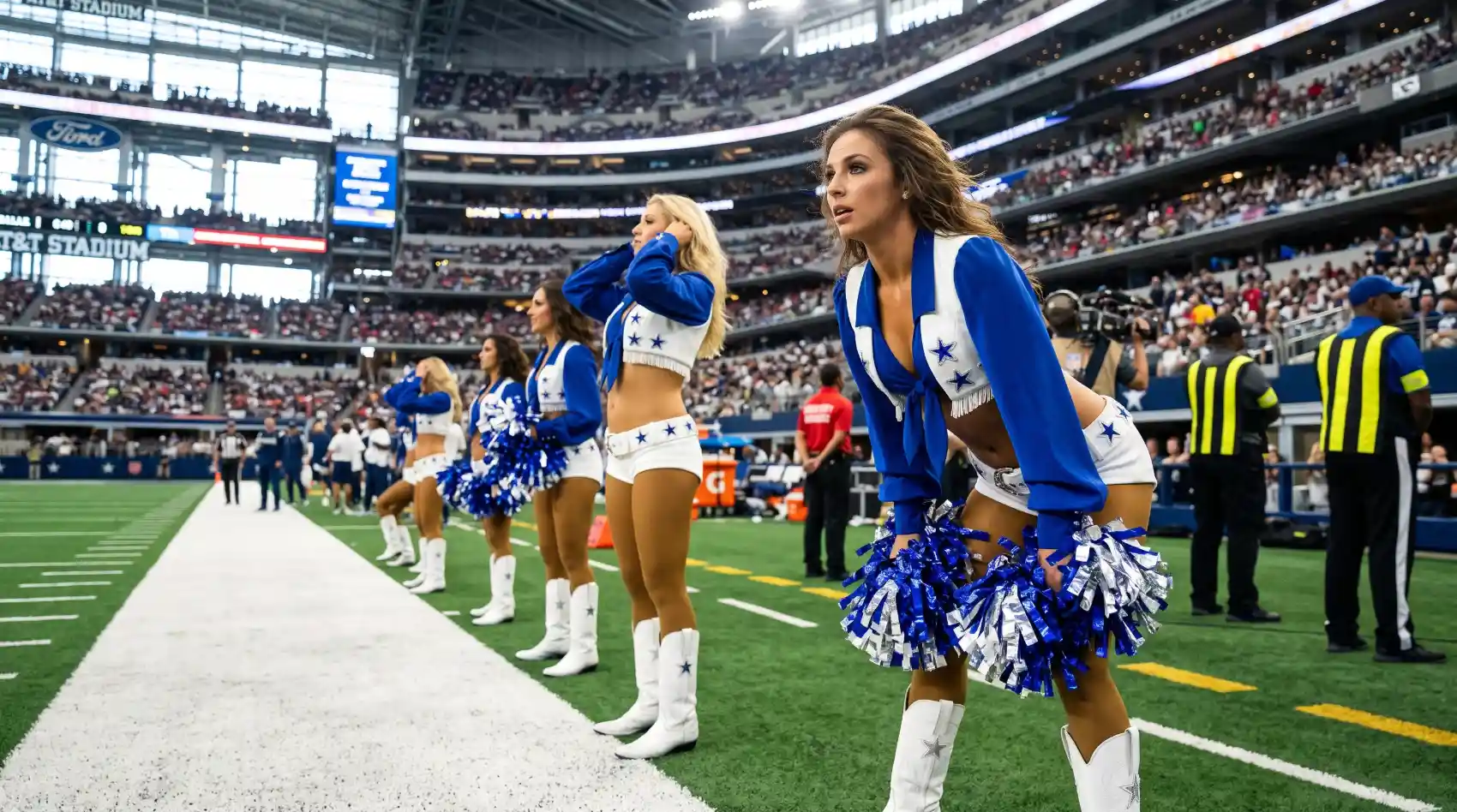
Dallas Cowboys Cheerleaders: Organizational Structure, Compensation, and Audition Mechanics
The Dallas Cowboys Cheerleaders (DCC) operate as the official 36-member professional dance and public relations squad of the NFL’s Dallas Cowboys. Rebranded in 1972 under general manager Tex Schramm into an athletic dance unit, the organization is managed at The Star in Frisco, Texas, under Executive Vice President Charlotte Jones, longtime Director Kelli Finglass, and Head Choreographer Judy Trammell.
Beyond performing at ten annual preseason and regular-season home games at AT&T Stadium in Arlington, the squad functions as an international media franchise. Between 16 seasons of CMT’s Making the Team (2006–2021) and Netflix’s docuseries America’s Sweethearts: Dallas Cowboys Cheerleaders (2024–present), the organization generates standalone brand equity through global USO tours, corporate appearances, and licensing—while drawing persistent scrutiny over the contrastDallas Cowboys Official DCC Portal between the franchise’s multi-billion-dollar valuation and cheerleader compensation.
Quick Facts & Verified Entity Summary
| Attribute | Verified Specification |
| Official Entity Name | Dallas Cowboys Cheerleaders (DCC) |
| Nickname | “America’s Sweethearts” |
| Founding Dates | 1960 (as CowBelles & Beaux); 1972 (modern all-female professional squad) |
| Executive Leadership | Charlotte Jones (EVP & Chief Brand Officer), Kelli Finglass (Director since 1991), Judy Trammell (Head Choreographer since 1991) |
| Headquarters & Venue | The Star (Frisco, TX) / AT&T Stadium (Arlington, TX) |
| Standard Active Roster | 36 cheerleaders (plus select All-Star alumni for external events) |
| Signature Field Routine | Pregame performance to AC/DC’s “Thunderstruck” featuring the 36-person linked jump split |
| Documented Pay Scale | $15–$20/hour (rehearsals, scaled by tenure) and $500 per home game day (post-2019 FLSA settlement adjustments) |
Organizational Evolution: From Sideline Novelty to Global IP
When the Dallas Cowboys joined the NFL in 1960, sideline entertainment consisted of the CowBelles & Beaux, a co-ed group of local high school students holding megaphones. That model lasted twelve years. During a 1967 home game at the Cotton Bowl, stripping entertainer Bubbles Cash walked down the stadium steps in a short miniskirt carrying cotton candy, drawing louder crowd reactions than the game on the field.
General manager Tex Schramm recognized the commercial potential of theatrical sideline entertainment. For the 1972 season, Schramm hired choreographer Texie Waterman to replace the high school squad with trained adult dancers capable of executing jazz and pom routines across a 100-yard turf field. Designer Paula Van Waggoner created the original royal-blue tie-front blouse, starred white vest, belted white shorts, and white boots. Aside from minor fabric updates for breathability and movement, the uniform remains virtually unchanged over five decades later, protected by federal trademark registrations and housed in the Smithsonian National Museum of American History.
Suzanne Mitchell, who served as director from 1976 to 1989, turned the squad into an independent revenue center. In January 1976, camera operators focused on cheerleader Gwenda Swearingen winking during Super Bowl X against the Pittsburgh Steelers, introducing the group to a national broadcast audience of 57 million viewers. By 1979, the DCC starred in a self-titled ABC television movie watched by nearly half of American television households and launched their first holiday USO tour to U.S. military bases in South Korea.
Audition Architecture and Training Camp Attrition
Securing one of the 36 spots on the active roster requires clearing a four-stage elimination funnel that runs from April through late July. Returning veterans hold no guaranteed roster spots; every veteran must re-audition annually alongside incoming rookie candidates.
-
Round 1: Digital Preliminary Submissions (April–May) Since 2020, initial screening begins with asynchronous video submissions. Candidates upload continuous, unedited recordings of free-form choreography demonstrating extension, turns, and field projection. Approximately 500 to 700 applicants submit annually.
-
Round 2: Semifinals & Panel Interviews (May) Roughly 120 to 150 advancing candidates travel to Frisco, Texas. They learn a technical DCC-style jazz/pom combination and the signature kickline sequence on the spot, supplemented by formal panel interviews testing NFL knowledge, current events, and media poise.
-
Round 3: Finals at The Star (May/June) Around 60 to 75 finalists compete in a full-day evaluation: personal interviews with Kelli Finglass, Charlotte Jones, and guest judges; a solo dance routine in costume; uniform fittings; and an on-field combination with the full linked kickline.
-
Round 4: Summer Training Camp (June–July) Between 42 and 45 training camp candidates (TCCs) are invited to a six-to-eight-week camp. Rehearsals run four to five nights per week from 6:30 PM to 11:00 PM so candidates can keep daytime employment. Candidates must master over 50 separate dance routines, pass written exams on Dallas Cowboys franchise history, maintain strict appearance standards, and survive night-by-night office cuts until the roster reaches 36 before the first preseason game in August.
Technical Physical Bottleneck: The Linked Jump Split
The single highest physical barrier in training camp is the linked jump split at the start of the “Thunderstruck” pregame routine. Thirty-six women hook arms in up to four staggered lines, execute a rapid eight-count progressive high-kick sequence, and leap straight up before landing directly in a full right-or-left front split on synthetic turf.
-
Biomechanical Risk: Because dancers’ arms are physically linked to their neighbors, a single dancer with delayed timing or shorter torso height can pull adjacent dancers off-axis mid-air, risking hamstring avulsions, hip labral tears, or knee hyperextensions upon impact.
-
Selection Rule: Candidates who cannot execute a flat jump split with linked arms without dropping their chest forward are routinely cut during the first two weeks of training camp, regardless of solo technical proficiency.
Compensation Mechanics, Legal Precedents, and Working Realities
Compensation for NFL cheerleaders has long lagged behind the league’s revenue growth, and the Dallas Cowboys Cheerleaders have been at the center of that labor debate.
In May 2018, former DCC member Erica Wilkins (who cheered from 2014 to 2017) filed a federal lawsuit in the U.S. District Court for the Eastern District of Texas under the Fair Labor Standards Act (FLSA). Wilkins alleged that the organization paid cheerleaders $8 per hour for practices and $200 per game day while failing to compensate them for mandatory hours spent at appearances, hair and makeup prep, and workouts. Her filing noted that her total annual DCC earnings hovered around $6,000 to $14,000, whereas the Cowboys’ costumed mascot, “Rowdy,” received an estimated $65,000 annual salary plus benefits.
The Dallas Cowboys settled the lawsuit out of court in September 2019. Following the settlement, the organization restructured its pay tiers:
-
Game-Day Compensation: Increased from $200 to $400–$500 per home game (with 10 home games per standard NFL calendar, including preseason, yielding $4,000 to $5,000 in base game-day income).
-
Rehearsal Hourly Rates: Raised to $12–$20 per hour, tiered by years of tenure on the squad.
-
Paid External Appearances: Paid on a tiered scale ranging from $100 to $500+ per corporate or charity booking, with senior veterans and “Show Group” members receiving priority booking volume.
As documented by first-hand testimony in Netflix’s America’s Sweethearts (2024), a fifth-year veteran with heavy appearance bookings can earn roughly $40,000 to $75,000 annually from combined DCC streams, while first-year rookies typically earn between $15,000 and $22,000. Consequently, almost every active squad member works a primary daytime career—ranging from pediatric nursing and orthodontics to real estate, corporate finance, and studio choreography—treating the 30-to-40-hour weekly DCC schedule as a demanding second job.
Historical Timeline of the Dallas Cowboys Cheerleaders
| Year | Milestone Event | Organizational & Cultural Impact |
| 1960 | Formation of CowBelles & Beaux | High school students provide traditional sideline cheering during the Cowboys’ inaugural NFL season at the Cotton Bowl. |
| 1972 | Professional Squad Relaunch | Tex Schramm and choreographer Texie Waterman debut 7 professional dancers in the star-spangled uniform designed by Paula Van Waggoner. |
| 1976 | Super Bowl X Broadcast Moment | A sideline close-up of DCC member Gwenda Swearingen winking on CBS turns the group into a national pop-culture story. |
| 1979 | The Dallas Cowboys Cheerleaders TV Movie & First USO Tour | The ABC television film draws a 48% national audience share; the squad launches its first overseas military tour to South Korea. |
| 1991 | Kelli Finglass & Judy Trammell Appointed | Former DCC alumni Finglass (Director) and Trammell (Head Choreographer) assume operational control, establishing the modern training camp era. |
| 2006 | Making the Team Premieres on CMT | The reality series runs for 16 seasons (through 2021), turning the summer training camp into a recruiting magnet for collegiate dancers nationwide. |
| 2018–2019 | Erica Wilkins FLSA Lawsuit & Settlement | Federal wage-and-hour litigation prompts the Cowboys to double game-day pay and revise hourly tracking for rehearsals and events. |
| 2024 | America’s Sweethearts Debuts on Netflix | Director Greg Whiteley’s documentary series brings global streaming visibility to the squad’s physical toll, faith culture, and wage structure. |
Frequently Asked Questions
How much do the Dallas Cowboys Cheerleaders make per year?
First-year rookies typically earn between $15,000 and $22,000 per season, combining $12–$15/hour rehearsal pay and $400–$500 per home game across ten games. Senior veterans in their fourth or fifth year who book frequent corporate appearances and holiday events can earn between $40,000 and $75,000 annually, though nearly all members maintain full-time day jobs.
How many cheerleaders make the final Dallas Cowboys squad?
The standard active roster consists of 36 cheerleaders each NFL season. Roughly 42 to 45 finalists enter summer training camp in June, and Director Kelli Finglass and Head Choreographer Judy Trammell make progressive cuts over six to eight weeks until 36 members remain for the opening preseason game.
Is there a height or weight requirement to audition for the DCC?
The Dallas Cowboys Cheerleaders do not enforce a minimum or maximum height requirement or a numeric weight limit on their application. However, candidates are judged strictly on proportional fitness, stamina, high-kick synchronization within the linked line, and maintaining the exact measurements recorded at their initial uniform fitting throughout the season.
Can Dallas Cowboys Cheerleaders date NFL players?
No. The DCC contract enforces a strict non-fraternization policy prohibiting cheerleaders from dating, socializing privately with, or contacting Dallas Cowboys players or coaching staff. Violating the fraternization clause results in immediate dismissal from the squad.
What is the maximum tenure for a Dallas Cowboys Cheerleader?
There is no formal cap on the number of years a woman can cheer for the Dallas Cowboys, provided she passes the annual audition process each spring. In practice, because of the physical toll of the linked jump split on hips and hamstrings alongside the 40-hour evening schedule, most cheerleaders retire after three to five seasons.
What do you feel about this post?

Like

Love

Happy

Haha

Sad

Angry

I am an independent writer and digital researcher tracking everyday trends, tech shifts, and modern culture across the US. I focus on cutting through internet noise to bring you crisp, honest stories and practical takeaways you can actually use.