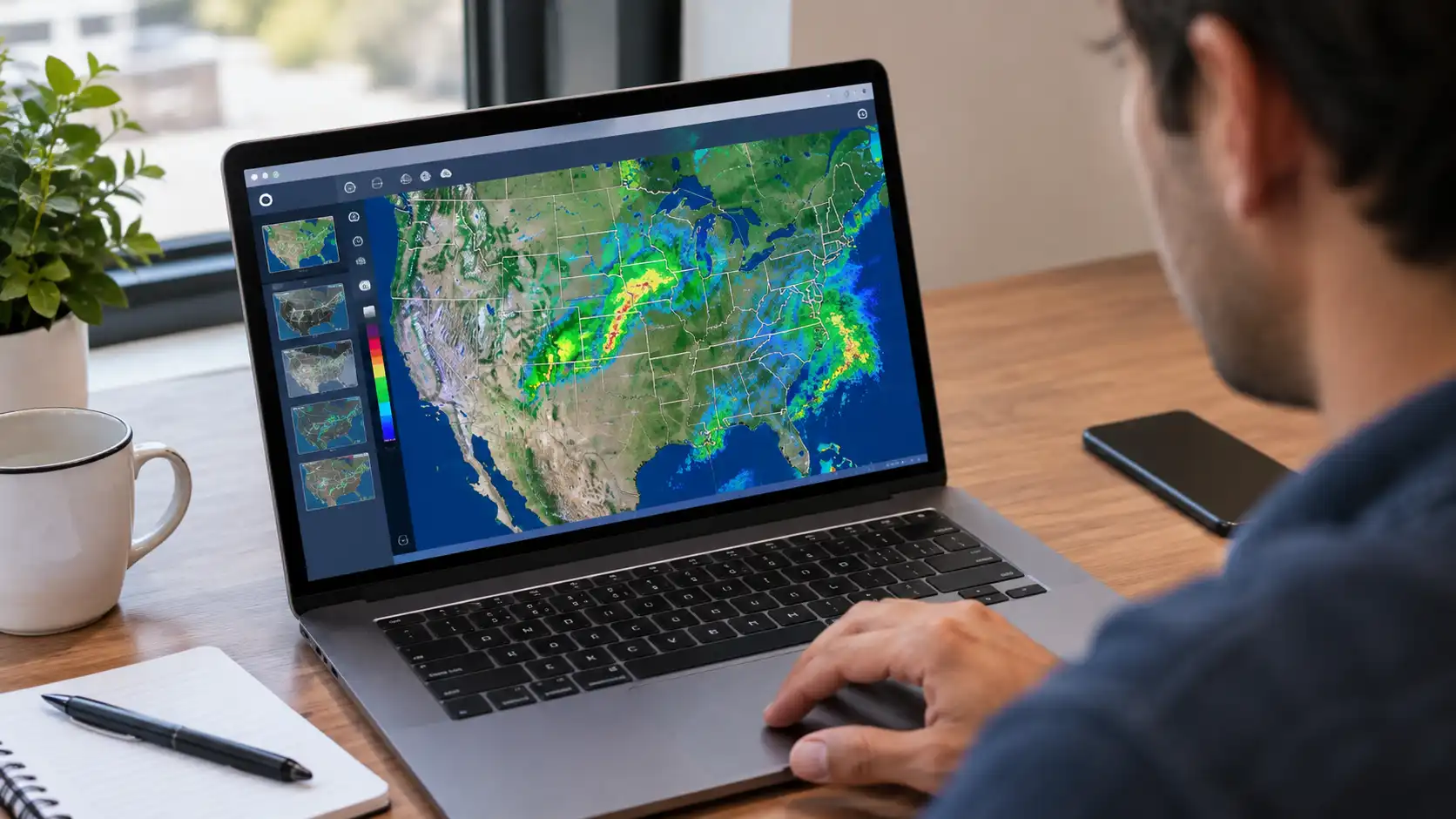
Intellicast is no longer available as a standalone weather website, but its weather maps have not disappeared entirely. The service began redirecting visitors to Weather Underground on January 17, 2019. As of October 2026, Weather Underground still lists an Intellicast-branded current radar map alongside its other weather tools.
Intellicast at a Glance
| Detail | Verified information |
|---|---|
| Original website | Intellicast.com |
| What happened | Integrated into Weather Underground |
| Redirects began | January 17, 2019 |
| Current radar access | Weather Underground’s Intellicast radar |
| Original website status | No longer operates as a standalone destination |
| Main weather features | Radar, satellite imagery, temperature, wind and surface analysis maps |
| Alternative official U.S. radar | National Weather Service Radar |
Sources: Weather Underground’s Intellicast page and its Maps Catalog, checked October 14, 2026.
What Happened to Intellicast?
Intellicast was a weather information service known for its map-based presentation of weather conditions. Instead of relying solely on a basic forecast, visitors could examine radar imagery, satellite views, temperature patterns and other meteorological maps.
The important change came in January 2019.
According to Weather Underground’s official Intellicast announcement, redirects from Intellicast.com to wunderground.com began on January 17, 2019. The company explained that the Intellicast name and standalone website would be retired while its technology and familiar features continued on Weather Underground.
That distinction matters today. Saying Intellicast completely disappeared is misleading because an Intellicast-branded radar option remains in Weather Underground’s current map catalog. However, that does not mean the original website has returned or that every former feature is available in precisely the same form.
The practical outcome is straightforward: people looking for the familiar Intellicast weather maps should start with Weather Underground rather than an old Intellicast bookmark.
How to Access Intellicast Weather Radar Today
The quickest route is Weather Underground’s dedicated Current Radar (Intellicast) page.
Follow these steps to find and use the map:
- Open the Intellicast radar link in your browser.
- Allow the page to load, and locate the area you want to inspect.
- Zoom in on your city or region to examine precipitation near your location.
- Compare the radar image with the map’s available time information and other weather products.
- Check an official National Weather Service warning before making decisions about potentially dangerous weather.
Weather Underground also provides a Maps Catalog with several related products. Depending on what you need, these include current radar, radar summaries, yesterday’s radar loop, satellite imagery, current wind maps, temperature maps and surface-analysis products.
Not every map answers the same question. Current radar is useful for seeing where precipitation is appearing, while satellite imagery provides a different view of cloud patterns. Surface-analysis maps help show broader weather features and forecast conditions.
One limitation to remember: a map’s presence in the current catalog confirms that the option is listed, but it does not guarantee uninterrupted service, identical historical functionality or the availability of every legacy feature.
What Can You Actually Learn From Intellicast Radar?
A weather radar map is most useful when you know what its colors and movement represent.
Track approaching rain and storms
Animated radar imagery can help you see whether precipitation is moving toward your area, moving away or developing nearby. Looking at several consecutive frames is more informative than judging conditions from a single static image.
For example, if a band of rain is approaching your city from the west, the animation can help you monitor its movement. It does not, by itself, establish exactly when rain will reach your street.
Distinguish radar from satellite imagery
These two products are frequently confused.
Weather radar displays signals returned by targets in the atmosphere. Meteorologists use radar data to detect precipitation, study storm structure and assess other features of developing weather systems.
Satellite imagery provides a view of clouds and atmospheric patterns. Infrared satellite images, for example, represent information related to cloud-top temperatures, while visible images show reflected sunlight and are therefore dependent on daylight conditions.
If your immediate question is whether rain is approaching, start with radar. For broader cloud development, compare it with satellite imagery.
Understand the limits of a radar image
Radar is not a perfect picture of conditions at ground level. Coverage can vary with distance from the radar, terrain and atmospheric conditions. A distant storm may be detected at an altitude that does not accurately describe what is happening near the surface.
Radar echoes can also occasionally reflect non-precipitation targets or other sources of interference.
For that reason, don’t interpret every colored patch as proof that rain is falling directly where the map shows it. Cross-check the display with current observations and the official forecast, especially during severe weather.
Is Intellicast Still Free?
Weather Underground offers an ad-supported option for its core features, according to its official subscription FAQs. It also offers a paid ad-free experience.
The distinction is important because Intellicast no longer operates as an independent website with its own separate service offering. Access, advertising and subscription arrangements are governed by Weather Underground’s current service.
The continued presence of an Intellicast radar label does not establish that every former Intellicast function is free. Nor should users assume that an old bookmark, screenshot or reference to a legacy feature guarantees that the same feature remains available.
Check the current page and its displayed options before relying on a particular tool.
Best Intellicast Alternatives in the United States
If the Intellicast radar page does not provide what you need, there are several practical alternatives.
| Weather tool | Best use | Main advantage |
|---|---|---|
| Weather Underground | Everyday weather maps and local conditions | Retains an Intellicast-branded radar option in its catalog |
| National Weather Service Radar | Monitoring precipitation and official weather warnings | Government-operated radar viewer with national and individual-station views |
| NOAA National Centers for Environmental Information | Historical radar research and archived observations | Provides access to radar archives, tools and data resources |
Weather Underground: Best starting point for former Intellicast users
Weather Underground is the logical first choice if you want to find the map associated with Intellicast. Its catalog brings together several radar, satellite, wind and temperature products.
Start with the Intellicast radar page. If that map fails to load or lacks a feature you remember, compare it with the other radar options rather than assuming the entire service has become unavailable.
National Weather Service: Best for official U.S. weather monitoring
The National Weather Service radar viewer offers both a national radar mosaic and individual radar-station products. It can display radar alongside forecast information and warnings.
Its official radar FAQ explains how to search for a location, choose map views, display warnings and interpret available radar products. The agency also provides information about radar status and troubleshooting.
For severe thunderstorms, flooding or other hazardous conditions, this is a particularly useful source to keep bookmarked. Radar imagery helps show what weather is doing; official warnings communicate hazards identified by the responsible authorities.
NOAA radar archives: Best for historical research
Current radar tells you what is happening now. Historical radar data serves a different purpose.
NOAA’s National Centers for Environmental Information radar resources include access to the NEXRAD and Terminal Doppler Weather Radar archives, along with tools for exploring historical observations.
The interactive radar archive offers access to data dating from 1995 onward for individual or multiple stations, subject to the available products and records. This makes the resource more suitable for researchers, weather enthusiasts and people investigating past weather events than for someone who only wants a quick local forecast.
How to Fix Intellicast Radar When It Will Not Load
A blank map does not automatically mean Intellicast radar has been discontinued. The page may be affected by a browser problem, a temporary service issue or an individual radar outage.
Try these checks in order.
1. Reload the page. Open the current Intellicast radar page directly instead of relying on a saved bookmark. An older link may point to a feature that has moved.
2. Refresh the browser cache. Cached page data can sometimes prevent a weather application from loading correctly. In Chrome on Windows or Linux, press Ctrl + Shift + R to force a reload.
3. Try another radar product. Compare the Intellicast-branded option with Weather Underground’s standard current radar or radar summary. If one works and another does not, that narrows the problem to the particular product or its loading path.
4. Check the official radar viewer. Open radar.weather.gov and search for your location. If the National Weather Service map also shows a blank local radar image, consult its radar FAQ, which explains how to check for offline equipment and other display problems.
5. Check the map’s timestamp. A visible radar image is not necessarily a fresh one. Look for the displayed time, compare it with another source and avoid treating stale imagery as a live view.
If a storm is approaching, don’t spend valuable time trying to restore a preferred map interface. Switch to a functioning official source and check current watches, warnings and local forecast information.
The Bottom Line on Intellicast
Intellicast’s standalone website was retired during its transition to Weather Underground in 2019, but the service’s legacy is still visible in the current radar catalog.
For former users, the best first step is to open the Intellicast-branded radar map. For official U.S. radar imagery and weather warnings, bookmark the National Weather Service radar viewer. For past radar observations, explore NOAA’s archive.
The key is to distinguish the old website from the weather tools that remain accessible. That saves time, avoids confusion over outdated links and helps you choose the right source for the task at hand.
Frequently Asked Questions
1. Is Intellicast still available?
The original Intellicast website no longer operates as a standalone destination. However, Weather Underground’s current Maps Catalog still lists an Intellicast-branded current radar map.
2. What happened to Intellicast.com?
Weather Underground began redirecting traffic from Intellicast.com on January 17, 2019. The standalone name and website were retired, while the company said the technology and features would continue on Weather Underground.
3. Where can I find Intellicast radar now?
Start at Weather Underground’s Current Radar (Intellicast). If it does not load or provide the information you need, try the standard Weather Underground radar or the National Weather Service radar viewer.
4. Is there an official alternative to Intellicast in the United States?
Yes. The National Weather Service radar viewer displays national radar mosaics and individual radar-station products, including weather information and warnings. NOAA’s National Centers for Environmental Information also provides historical radar resources.
5. Can Intellicast radar predict exactly when rain will reach my location?
No. Radar animation helps you follow precipitation and estimate its direction of movement, but it cannot guarantee an exact arrival time at your location. Combine radar imagery with the local forecast, current observations and official warnings.
What do you feel about this post?

Like

Love

Happy

Haha

Sad

Angry

I am an independent writer and digital researcher tracking everyday trends, tech shifts, and modern culture across the US. I focus on cutting through internet noise to bring you crisp, honest stories and practical takeaways you can actually use.