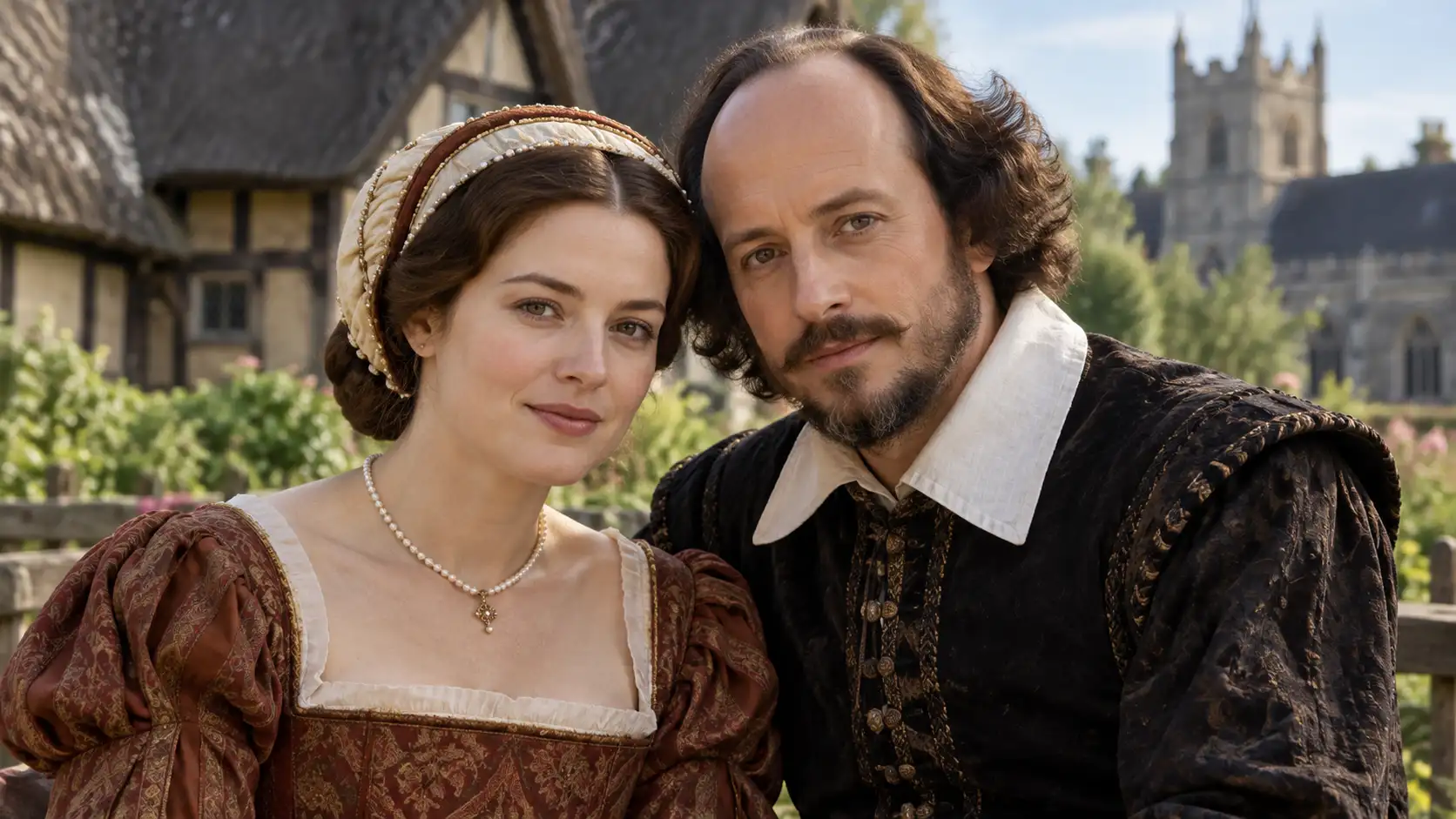
Anne Hathaway was the wife of William Shakespeare. Born around 1556 near Stratford-upon-Avon, she married Shakespeare in late 1582 and had three children with him: Susanna, Hamnet, and Judith. She remained his wife until his death in 1616.
Far less is known about Anne than about her famous husband. The surviving evidence comes from wills, parish registers, marriage records, property history, and a small number of other documents. Those records give a clear outline of her life, but they cannot tell us exactly what her marriage was like or what she thought about Shakespeare’s career.
Quick Facts
| Detail | Information |
|---|---|
| Full name | Anne Hathaway, later Anne Shakespeare |
| Also recorded as | Agnes Hathaway |
| Born | Around 1556 |
| Birthplace | Shottery, near Stratford-upon-Avon, England |
| Father | Richard Hathaway |
| Husband | William Shakespeare |
| Married | Late November 1582 |
| Children | Susanna, Hamnet, and Judith |
| Family home | Stratford-upon-Avon; later associated with New Place |
| Husband died | 1616 |
| Anne died | August 6, 1623 |
| Buried | Holy Trinity Church, Stratford-upon-Avon |
Anne’s exact birth date is unknown, but the Shakespeare Birthplace Trust places her birth around 1556. The Holy Trinity Church register records her burial on August 8, 1623.
Who Was Anne Hathaway Before She Married Shakespeare?
Anne grew up in Shottery, a small settlement about a mile and a half from Stratford-upon-Avon. Her father, Richard Hathaway, was a prosperous yeoman farmer. The Shakespeare Birthplace Trust identifies Anne as the eldest of seven surviving children in the Hathaway family.
Her family lived at Hewlands Farm, the property now known as Anne Hathaway’s Cottage. The farmhouse dates to the 15th century and remained connected with Hathaway descendants for generations. Today, it is preserved by the Shakespeare Birthplace Trust.
Richard Hathaway died before his daughter’s marriage. His will, dated September 1, 1581, survives in the records of The National Archives. It is especially interesting because he referred to his daughter as Agnes, a detail that has led modern writers to question whether Anne was simply another form of the name used for her.
Anne Hathaway and William Shakespeare’s Marriage
Anne Hathaway married William Shakespeare in late November 1582. She was about 26, while Shakespeare was 18. Anne was already pregnant with their first child at the time of the marriage.
One of the most important surviving records is a marriage bond dated November 28, 1582. Two men connected with the Hathaway family, Fulk Sandells and John Richardson, guaranteed that there was no legal obstacle preventing the marriage. Because Shakespeare was under age, he could not act as his own surety.
The precise wedding location has not been established. The documentary record also contains a famous puzzle: a Worcester register dated November 27 names a bride called Anne Whateley of Temple Grafton, while the bond created the next day clearly names Anne Hathaway. Shakespeare Documented notes that the original bond is more likely to be accurate and that the Whateley entry may have resulted from a clerical mistake.
Anne’s pregnancy has sometimes been used to portray the marriage as forced or unhappy. The surviving records do not support such a firm conclusion. The Folger Shakespeare Library notes that pregnancy before marriage was not an exceptional situation in the period, and there is too little personal evidence to determine the couple’s feelings toward one another.
Anne Hathaway and Shakespeare’s Children
Anne and William had three children. Their first daughter, Susanna Shakespeare, was baptized at Holy Trinity Church on May 26, 1583, roughly six months after the marriage records were created.
Twins Hamnet and Judith Shakespeare were baptized on February 2, 1585. Hamnet, the couple’s only son, died in 1596 at the age of 11. Judith survived into adulthood, as did Susanna.
Hamnet’s early death has attracted particular attention because of the similarity between his name and the title Hamlet. Historians know that Shakespeare experienced the death of his son, but attempts to reconstruct exactly how that loss shaped the play move beyond what the surviving documentary evidence can prove.
Family Life While Shakespeare Worked in London
For much of Shakespeare’s theatrical career, Anne and the children were associated with Stratford while he spent substantial periods working in London. That arrangement has sometimes been treated as evidence of an unhappy marriage, but physical separation was also a practical consequence of Shakespeare pursuing a theatrical profession centered in London.
The picture may be more complicated than older biographies suggested. In 2025, scholar Matthew Steggle published research concerning a fragmentary letter addressed to “Good Mrs Shakspaire.” His analysis argues that it could refer to Anne and may indicate that she once lived in London’s Trinity Lane.
The identification is not certain. Scholars quoted by the Folger described the argument as plausible and significant while emphasizing that it is not conclusive. If Steggle’s identification is correct, Anne may have spent more time in London with her husband than historians previously assumed.
Anne Hathaway and New Place
In 1597, Shakespeare purchased New Place, one of the largest houses in Stratford-upon-Avon. It became the principal Shakespeare family home and contained an estimated 20 to 30 rooms.
Anne is generally understood to have lived there during the later part of her marriage. After William’s death in 1616, ownership of New Place passed to their eldest daughter Susanna and her husband, physician John Hall. Anne continued living with the family until her death in 1623.
Her position within this household is worth remembering. Although the historical record says little about her personality, she was part of a substantial Stratford property-owning family by the later years of Shakespeare’s career rather than simply a distant figure left behind while he lived in London.
Why Did Shakespeare Leave Anne His “Second Best Bed”?
Few details about Anne Hathaway have caused more debate than Shakespeare’s will. He famously left his wife his “second best bed with the furniture.” The phrase was inserted into the will and is the only specific bequest to Anne recorded there.
It has sometimes been interpreted as a final insult, but historians warn against reading modern assumptions into the wording. Beds were expensive household possessions, and terms such as “best” and “second best” could simply distinguish one item from another. The Shakespeare Birthplace Trust also notes the possibility that the best bed was reserved for guests while the second-best bed was the couple’s marital bed. That interpretation is possible, not proven.
The will therefore cannot reliably tell us whether Shakespeare’s marriage was affectionate, distant, or troubled. Surviving evidence is simply too limited to support a confident emotional biography.
Why Is Anne Hathaway Sometimes Called Agnes?
The use of Agnes has become more visible because Maggie O’Farrell used that name for Shakespeare’s wife in her novel Hamnet, and the name continued into the later screen adaptation.
The historical basis is real: Richard Hathaway referred to his daughter as Agnes in his 1581 will. Folger material discussing Hamnet confirms that O’Farrell deliberately drew the name from that document.
That does not make the familiar name Anne incorrect. Historical spelling and naming practices were less standardized than they are today, and the surviving Shakespeare marriage documents identify her as Anne Hathaway.
Anne Hathaway’s Death and Burial
Anne outlived William Shakespeare by seven years. She died on August 6, 1623, at about 67 years old and was buried two days later. The parish register records her burial on August 8.
She was buried beside her husband in the chancel of Holy Trinity Church in Stratford-upon-Avon. Her grave and the preserved Hathaway family home have helped keep her connected with Shakespeare’s story four centuries after her death.
What We Still Do Not Know About Anne Hathaway
The biggest mistake in writing about Anne is filling gaps in the record with certainty. Historians do not know exactly how Anne and William met, the emotional circumstances of their marriage, how she felt about his London career, or what she looked like. The Shakespeare Birthplace Trust notes that the earliest known supposed depiction of Anne dates from 1708, decades after her death, so it cannot securely establish her appearance.
What can be documented is more modest but dependable. Anne came from the Hathaway family of Shottery, married Shakespeare in 1582, became the mother of his three children, lived into the family’s prosperous years at New Place, survived him by seven years, and died in 1623.
Her limited documentary record has allowed later generations to imagine many different versions of her. Separating those interpretations from surviving evidence gives a clearer picture of Anne Hathaway—not simply as “Shakespeare’s wife,” but as a real woman whose life can only partly be recovered from the records that remain.
FAQs
How old was Anne Hathaway when she married William Shakespeare?
Anne Hathaway was about 26 when she married William Shakespeare in late 1582. Shakespeare was 18.
How many children did Anne Hathaway and Shakespeare have?
Anne and William Shakespeare had three children: Susanna, born in 1583, and twins Hamnet and Judith, baptized in 1585.
Why did Shakespeare leave Anne Hathaway his second-best bed?
Shakespeare’s will left Anne his “second best bed with the furniture.” Scholars caution that this wording does not prove he meant to insult her; beds were valuable household goods, and the description may simply have identified a specific bed.
Was Anne Hathaway also called Agnes?
Anne Hathaway is sometimes called Agnes because her father, Richard Hathaway, referred to her as Agnes in his 1581 will. Modern works such as Hamnet use that name, but she is traditionally known as Anne Hathaway.
Source list
- Shakespeare Birthplace Trust: Anne Hathaway, Access Date: September 30, 2026.
- Folger Shakespeare Library: Shakespeare’s life, Access Date: September 30, 2026.
- Shakespeare Documented / Folger Shakespeare Library: The Shakespeare marriage bond, Access Date: September 30, 2026.
- Shakespeare Documented / Folger Shakespeare Library: Entry in the Bishop’s register concerning the marriage of William Shakespeare and Anne Hathaway, Access Date: September 30, 2026.
- Shakespeare Documented / The National Archives: Richard Hathaway’s last will and testament: original copy, Access Date: September 30, 2026.
- Shakespeare Documented / Folger Shakespeare Library: William Shakespeare’s last will and testament: original copy including three signatures, Access Date: September 30, 2026.
- Shakespeare Birthplace Trust: The Second-Best Bed, Access Date: September 30, 2026.
- Folger Shakespeare Library: New discoveries about the Shakespeare marriage, Access Date: September 30, 2026.
What do you feel about this post?

Like

Love

Happy

Haha

Sad

Angry

I am an independent writer and digital researcher tracking everyday trends, tech shifts, and modern culture across the US. I focus on cutting through internet noise to bring you crisp, honest stories and practical takeaways you can actually use.